
PSI develops, builds and operates complex large research facilities. PSI has the world's most powerful muon source, a unique proton and neutron source, an synchrotron of international importance and one of only five X-ray free-electron lasers with hard X-rays in the world. Scientists from all over the world use PSI's large research facilities for their scientific investigations. They are also available to Swiss research and industry for their experiments.
For researchers

Quality over energy in X-ray production
High-quality electron beams pave the way for more compact and affordable X-ray free-electron lasers.

First positrons for the Future Circular Collider
At Paul Scherrer Institute PSI, positrons have been successfully produced at a test source for CERN’s proposed next-generation particle collider.

A window on a cold quantum world
At SwissFEL, scientists get a rare glimpse into the quantum states that emerge at extremely low temperatures.
For researchers

Prestigious research grant for spin-quantum combination
From two to one: Giacomo Sala is combining two separate worlds of physics at PSI – the established field of spintronics and the emerging field of quantum geometry. The ERC is funding his highly innovative project with approximately CHF 2.2 million. It could pave the way for more efficient data storage.

How the “unicorn of the seas” got its helix
Synchrotron light reveals for the first time how the spiral form of the narwhal tusk is created by the arrangement of nanometre-sized building blocks.

Combating cancer growth
Researchers at PSI and the University of Zurich have determined the mechanism behind an important signalling protein that spins out of control in certain types of cancer. This paves the way for new approaches to cancer treatment.
For researchers
Latest News
Prestigious research grant for spin-quantum combination
From two to one: Giacomo Sala is combining two separate worlds of physics at PSI – the established field of spintronics and the emerging field of quantum geometry. The ERC is funding his highly innovative project with approximately CHF 2.2 million. It could pave the way for more efficient data storage.

What a dry meteorite tells us about water on Mars
Neutron and X-ray tomography show where water is bound inside a Martian meteorite – offering new insights into the early history of Mars.

A world-first lens brings neutrons into sharper focus
From thick samples to processes inside bulky equipment, a new type of lens opens the door to high-resolution neutron imaging of working systems.
For researchers
Latest News

Novel Particle Beam Could Challenge Einstein’s Theory of Gravity
An intense, cold beam of muonium will allow researchers to test the universality of free fall.

Quantum material under pressure
High pressure enhances superconductivity in a quantum material and alters its properties. PSI researchers have uncovered the microscopic mechanism behind this effect.

Important funding for muon research
PSI gets an NCCR: The Muoniverse project will further expand research on the beamlines for elementary particles called muons – at the world’s leading facility for muon beams.
For researchers
Novel Particle Beam Could Challenge Einstein’s Theory of Gravity
An intense, cold beam of muonium will allow researchers to test the universality of free fall.

Neutrons don’t disappear into the mirror world
Do mirror particles exist for all elementary particles? PSI researchers have succeeded in largely ruling out this hypothesis in particle physics – with unprecedented experimental precision.

Lord of the data
Between physics and software: Stefan Ritt and his work at the limits of measurement. A portrait in data, experiments, and “forbidden” decays.
News
Novel Particle Beam Could Challenge Einstein’s Theory of Gravity
An intense, cold beam of muonium will allow researchers to test the universality of free fall.
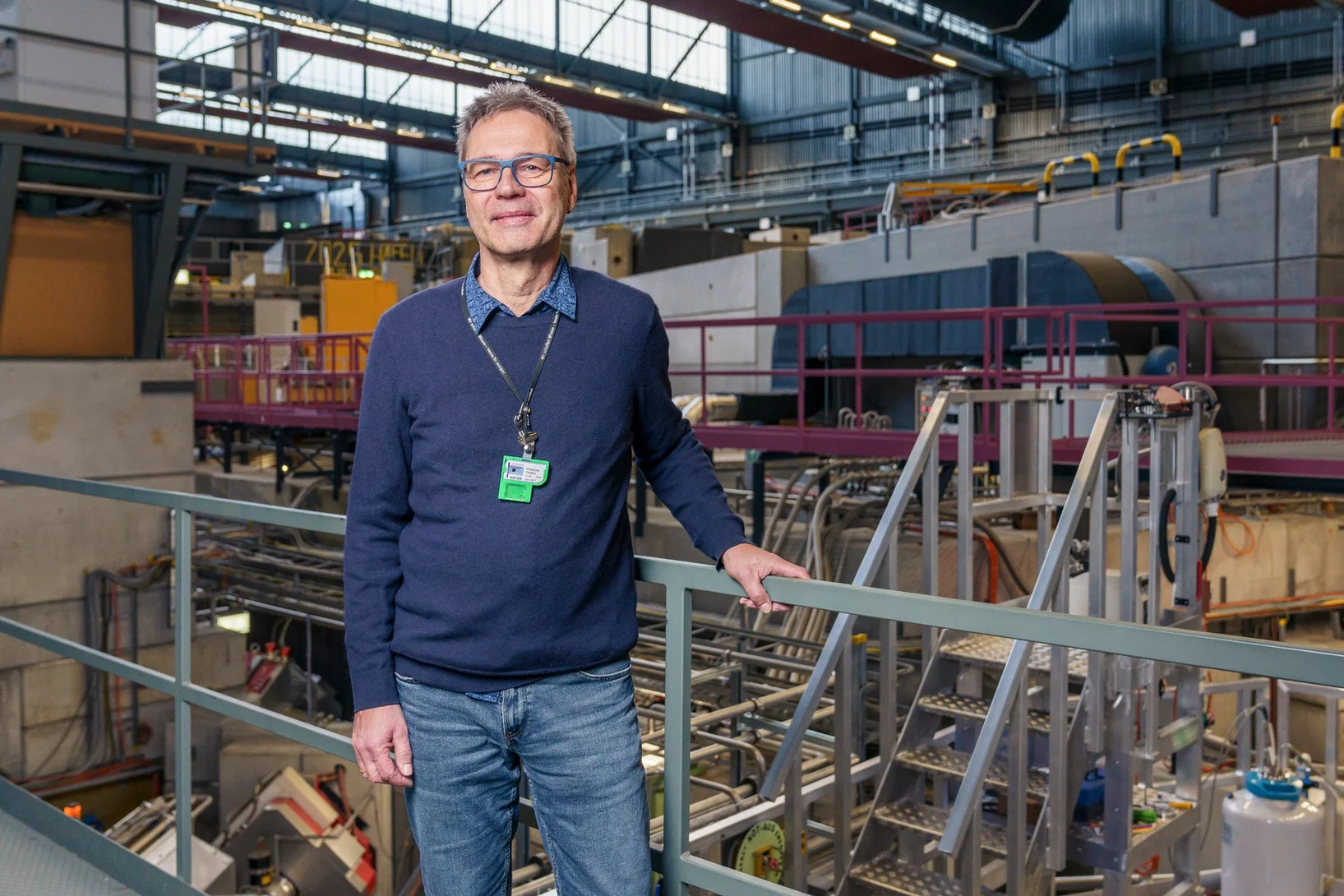
“We’re pulling out all the stops”
PSI is increasing the intensity of its muon beams a hundredfold. This opens up entirely new possibilities for physics and materials research.

New standards in nuclear physics
With unprecedented precision: PSI researchers measure the nuclear radius of muonic helium-3 and put the theories of atomic physics to the test.
Further Facilities
In addition to the Large Research User Facilities, further PSI laboratories are also open to external users.