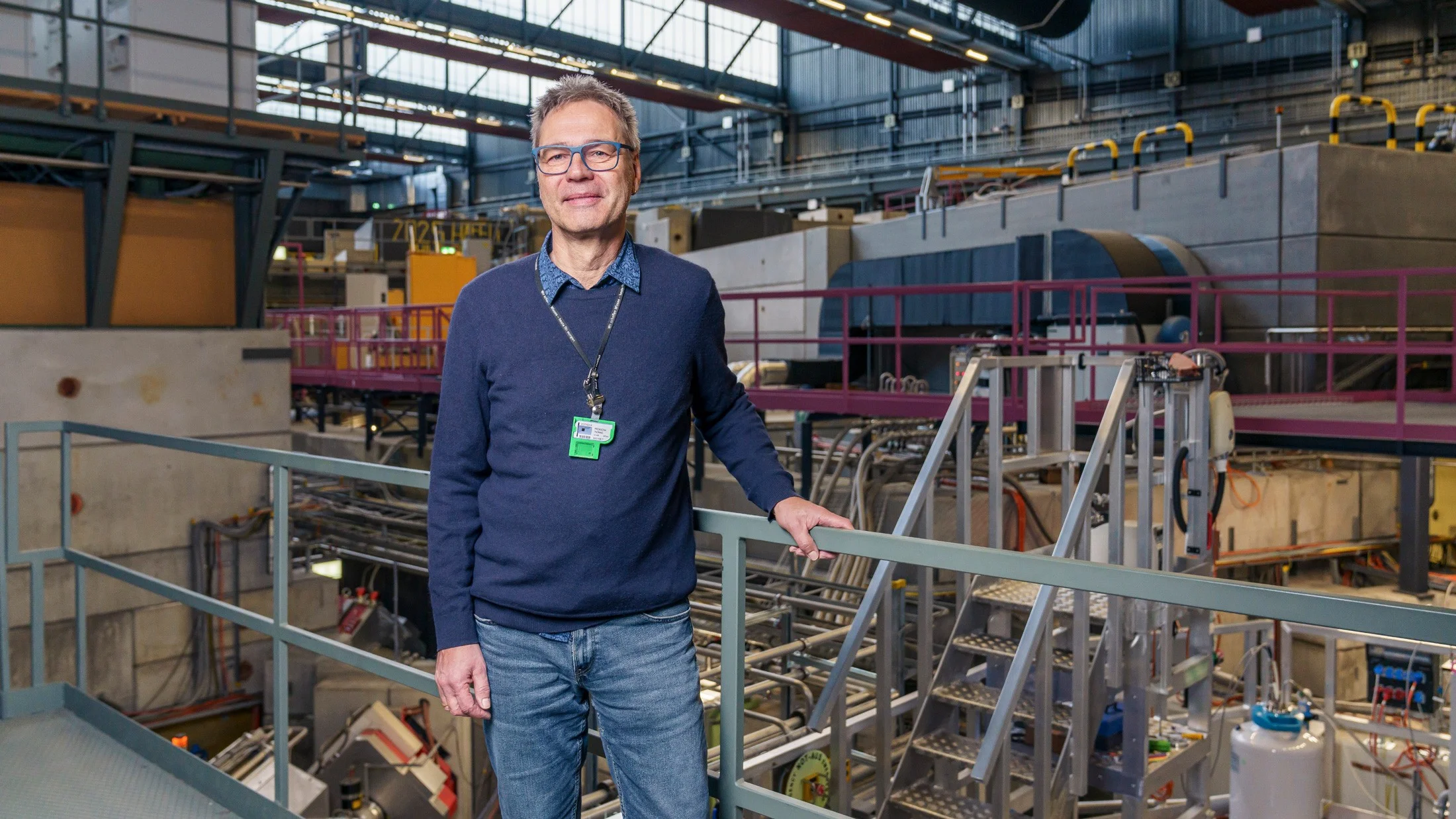
The upgrade of two high-intensity muon beams within framework of the IMPACT project is entering its critical phase. For many years, the muon facility of the Paul Scherrer Institute PSI has been delivering the world’s most powerful muon beams. Experimental physicist Thomas Prokscha is interim head of the Laboratory for Muon Spin Spectroscopy at the PSI Center for Neutron and Muon Sciences. He explains how an additional hundredfold increase in performance will be achieved in the future and what extraordinary research opportunities this will open up.
One of the two parts of the IMPACT upgrade project is referred to as HIMB, short for High-Intensity Muon Beams. Could you briefly explain the idea behind it?
Thomas Prokscha: One of the most important facilities here at PSI is HIPA, which stands for High-Intensity Proton Accelerator. It serves three large research facilities, each with a multitude of experimental stations. For my team, muon production is of special interest. We have the most intense muon beams in the world. That’s why many research groups come to us to conduct experiments. But the other research institutes aren’t standing still either and are constantly improving. With IMPACT, therefore, we want to significantly extend our lead once again, to future-proof the facility for many years to come. The two High-Intensity Muon Beams, which are part of the IMPACT project, are expected to achieve a hundred times higher intensity – that is, they will contain a hundred times more muons.
Which research areas will benefit from this?
The two new muon beamlines will serve very different research questions. First, there is fundamental physics research. Here, either the properties of muons themselves are measured with extreme precision or muons are used to determine the radius of protons and other atomic nuclei. Such experiments provide important insights into the fundamental laws of nature and allow the theories of particle physics to be rigorously tested, whereby the hundred times higher beam intensity will enable unprecedented precision.
Second, the muon beam can be used to investigate materials – but in contrast to X-ray imaging, we obtain information about the material properties from the muons that stop at interstitial sites in the material. My research team is also active in this field, known as muon spin spectroscopy.
In muon spin spectroscopy, a beam of muons is directed at the sample under investigation. The muon beam is polarised, meaning the spins (“magnetic needles”) of the muons are all aligned in one direction. The muons then enter the sample, their magnetic needles rotating according to the magnetic properties of the material. Many of the short-lived muons stop within the sample, decay there, and emit positrons preferentially in the direction of their spin. These positrons – the antiparticles of electrons – can be measured with detectors. This provides important insights into the magnetic properties of the material.
Can you walk us through what that is?
Muons are essentially the heavier siblings of electrons. Like electrons, muons possess an electric charge and, with their so-called spin, a small magnetic moment. Because muons are themselves magnetic thanks to their spin, and because they stop within the material, in contrast to X-rays, they provide additional crucial information about the magnetic fields within a material. Therefore, muon spin spectroscopy offers us exciting and unique opportunities to learn about the magnetic properties of a wide variety of materials. Currently, however, the experimental possibilities are still somewhat limited.
Is this due to the intensity of the muon beam?
That’s not the only reason. We already have the most intense muon beams in the world. But currently, we can usually only use a portion of the muons, not all of them, for muon spin spectroscopy. So we want to improve in two ways: First, we want to have significantly more muons available, and second, we want to make a larger proportion of them usable.
What are the limiting factors?
Within the sample, the muons decay into other particles, in particular positrons, the antiparticles of electrons. However, the rate at which we can currently measure this is limited. At the moment, we can only measure one muon at a time when it hits the sample. This is because we don’t know exactly which muon exits the beam and where it enters the sample. Therefore, we have to work with time intervals and can only take data when a single muon has been in the sample for a short time before it decayed. Currently, we manage to do this up to 40,000 times per second.
But you expect this to improve significantly in the future?
Exactly, we want to collect much more data in a shorter time. And we will then also be able to examine significantly smaller samples. This is important for many groups of researchers who come to us with entirely new types of materials. It is often very difficult to produce larger samples of such novel materials, that is, with a diameter of more than one millimetre. With the upgrade, we will also be able to examine these in detail.
IMPACT is an upgrade at the proton accelerator facility at PSI, which will be implemented beginning in 2025. IMPACT stands for Isotope and Muon Production with Advanced Cyclotron and Target Technologies. IMPACT consists of two parts: HIMB and TATTOOS.
HIMB stands for High-Intensity Muon Beams. HIMB is a joint undertaking of PSI and the University of Zurich. It involves a modification of the muon facility so that, in the future, up to ten billion muons per second can be used for research.
TATTOOS stands for Targeted Alpha Tumour Therapy and Other Oncological Solutions. TATTOOS is a collaboration between PSI, the University of Zurich, and the University Hospital of Zurich. It includes a new facility for isotope production where radionuclides for targeted cancer therapy and diagnostics will be produced.
What technical changes are necessary for this?
Simultaneous illumination with many muons is made possible by the significant advances in detector development in particle physics. Our collaborators in Mainz and Heidelberg have developed a so-called monolithic silicon pixel detector with unique characteristics. With a thickness of around 50 micrometres, it is much thinner than previous detectors. As a result, it barely disturbs the muons and their associated decay positrons. We simply install such detectors around the sample. This allows us to know when and where how many muons strike the sample and which decay positron belongs to which muon. In this way, we can use a much more powerful muon beam. Previously, this would not have been possible at all. In the future, these detectors will be further improved in collaboration with the PSI Laboratory for Particle Physics.
And how do you manage to increase the power of the muon beam?
To achieve such a significant improvement and bring roughly one hundred times more muons into the beam, we have to pull out all the stops. To understand this, one must know that muons are exotic, short-lived particles that themselves arise as secondary products from particle collisions. To produce the muons, we first fire the proton beam from the particle accelerator HIPA at a graphite target. In this material, the protons interact with carbon nuclei, producing so-called pions, which in turn decay almost instantaneously into muons. We then have to collect these muons using special magnets. Thanks to a newly developed magnet system at PSI, we will gain a tenfold increase in muons compared to the old system. We gain another tenfold increase from improved transport between the graphite target and the experiment. Previously, many muons were lost along this path. Here, too, the new magnet system plays a crucial role.
What kinds of measurements will HIMB make possible?
In the future, we will be able to perform what is essentially 3-D magnetic tomography with muons. And we will be able to do so much faster and with better resolution than before. This will give us a sharper view inside the materials. Especially regarding magnetic materials, novel quantum materials, and superconductors, this opens the way for exciting insights that are hardly obtainable with other methods.
And in the future, we also will be able to examine significantly smaller samples of only about one millimetre in diameter. Until now, the lower limit was around four millimetres. This improvement is significant because new materials often cannot be produced in large quantities, with sizes typically measuring a few millimetres or less. With the new facility, it will become practical for many research groups to use muon spin spectroscopy for the very first time.
Have you already received a lot of inquiries?
Research groups from all over the world are already inquiring about the new possibilities. First, though, we have to renovate the facility. This will take place during a major operational shutdown from 2028 to mid-2029. Between now and then, a lot of work awaits us all to get perfectly prepared. If everything goes according to plan, we’ll certainly receive a large number of inquiries. We’re eager to see if industrial customers will also want to use the system. So far, we’ve collaborated primarily with partners from the scientific community. Currently, there are many start-ups in the field of quantum technology, developing new quantum materials for example. Muon spin spectroscopy could prove very helpful in this area. I can easily imagine that we’ll have some customers from this sector in the future.
Contact
Dr. Thomas Prokscha
PSI Center for Neutron and Muon Sciences
Paul Scherrer Institute PSI
+41 56 310 42 75
thomas.prokscha@psi.ch
[German, English]