Lorenz Moser works as an electrical engineer at the Paul Scherrer Institute PSI. For the upgrade of the Swiss Light Source SLS, he became a meticulous restorer of circuit boards.

A complex project like the upgrade of a large research facility is the result of teamwork. It also requires the expertise of individuals for some particular components. The fact that the Swiss Light Source SLS was re-inaugurated successfully and on schedule in August 2025 – after completion of the extensive SLS 2.0 upgrade project – is due in part to the team of Thomas Schilcher, who heads the Electronics and Control Systems department in the PSI Center for Accelerator Science and Engineering. And to Lorenz Moser, the electrical engineer who optimised the hardware and software of one special component: the beam position monitor (BPM).
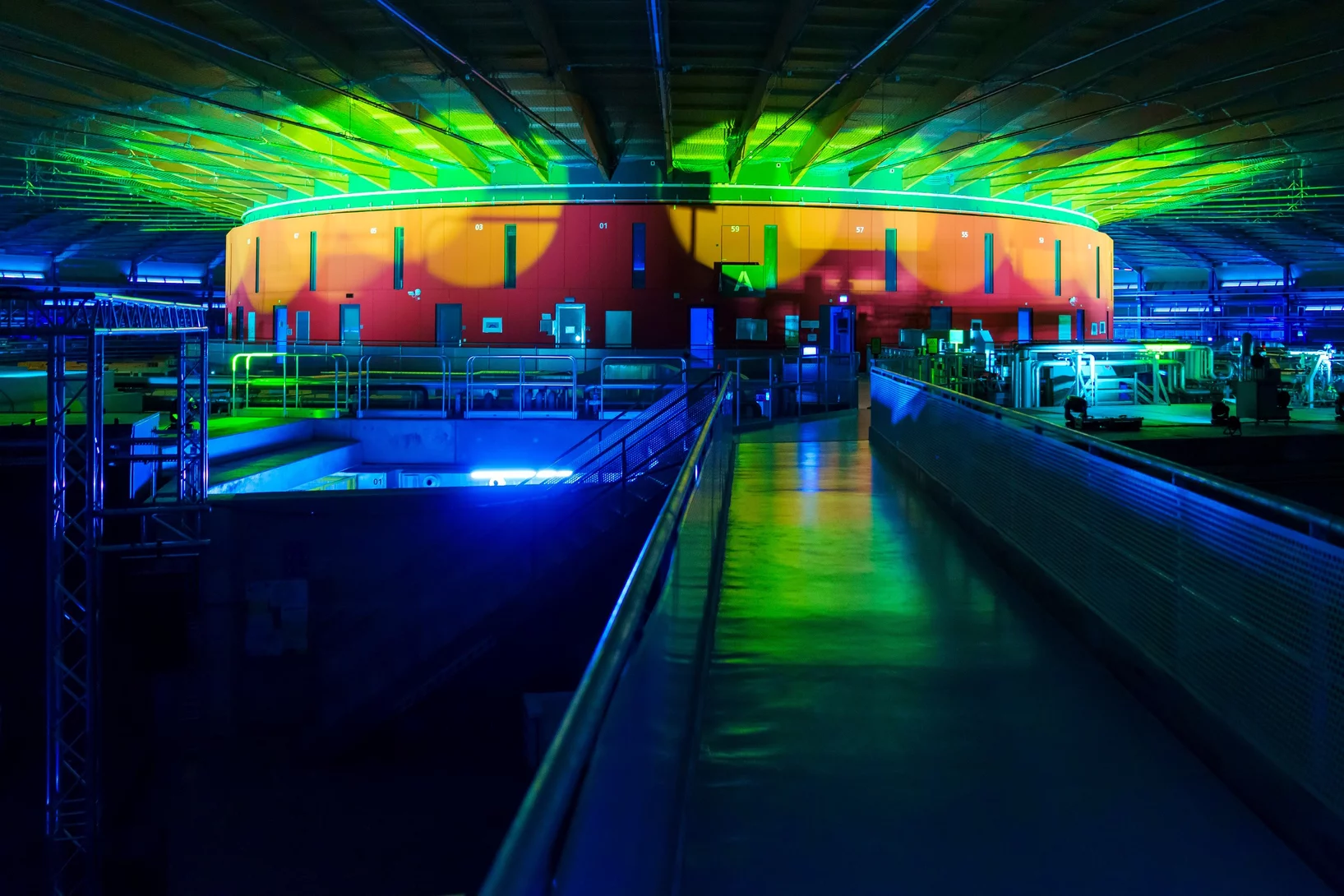
“Lorenz Moser was indispensable for the pre-accelerator chain,” says Thomas Schilcher. This part of SLS accelerates electrons to nearly the speed of light. The electron beams must remain precisely in position within the vacuum pipe where they whiz around in a circle. Once they reach their target speed, they are transferred to the slightly larger electron storage ring, where they generate the synchrotron radiation that gives SLS its name. This part of the facility was completely modernised as part of the upgrade, and SLS now delivers even better synchrotron light for numerous research projects in areas including health care, climate science, energy research, and future technologies.
The pre-accelerator, however, was initially retained and therefore required its own upgrade. The original BPM dates back to the late 1990s. When it was designed, Lorenz Moser was just starting primary school.
A passion for electronics
The Swiss engineer with Dutch roots developed a passion for electronics very early on. First there was his father, a pilot and passionate model builder: “Model boats, race cars, airplanes: we built a lot of things and got them running,” recalls the now 35-year-old. Moser’s other great passion also influenced his career path: music, specifically the guitar, first classical, then electric. “Then electronics automatically came into play again, with distortion pedals, amplifiers, and everything else that goes with it.” To this day, Moser plays in bands – for the past ten years with the Brugg-based Rude Tins. Their style: ska-punk with a brass section.
So it was clear: “Something with electronics” would determine his professional path. He chose an apprenticeship as an electronics technician. A path he can recommend in retrospect: “You learn the practical skills; you can always acquire deeper theoretical knowledge later on. For me, it was definitely worth it.” He then went on to complete a degree in electrical and information engineering at the University of Applied Sciences Northwestern Switzerland (FHNW).
After graduating with his bachelor’s degree, Moser applied to the Paul Scherrer Institute PSI, initially for a temporary project position as a technical employee. It sounded interesting, involving hardware development and work on complex systems. “The Swiss Light Source SLS was built from the ground up when I was ten years old, and as a teenager I visited a few times. It was simply impressive!” And as it turned out, he got the job: “They wanted me! So I started – and then moved from project to project.” That was in 2016. He now has a permanent position.

Circuit board forensics
Then, in 2020, work began on the SLS 2.0 upgrade. In 2023, Lorenz Moser and his colleague Werner Sturzenegger started rigorously testing every single circuit board of the old beam position monitor. “We were essentially conducting electronic forensics,” says Sturzenegger. And Moser adds: “You can never just hope something that worked flawlessly for years will work the same way after removal and reinstallation.”
This meant checking all the connectors, repeating calibrations, and rewriting test scripts. These were based on outdated versions of the software. “It can happen that a program doesn’t even run on the latest version,” Moser says. Figuring out what triggers one particular nonspecific error can be extremely difficult and time-consuming: is it a faulty cable, a brittle solder joint, a defective capacitor – and can this circuit board be refurbished? Or was it the software after all?
Finally, it was time for reinstallation. Here, Lorenz Moser and Thomas Schilcher shared the work. Hardware, software, control systems, network, operating system – once again, the task was to find and fix overlapping errors. Moser and his colleagues never took the easy way out. Operating a large research facility requires systems that run reliably – but you also have to understand every single process precisely to know why they work.
That the integration was successful – the colleagues agree – was due in no small part to Lorenz Moser, his tenacity, and his perseverance. “I wouldn’t trust every engineer with that,” says Sturzenegger. Moser himself takes a more pragmatic view. “If there are things to be done, then I'm not too proud for any task. I just do it.”
Restart
While SLS now delivers brilliant synchrotron light better than ever before, enabling cutting-edge research, the venerable BPM is now in a stable interim phase: in a few years, it will be completely replaced by a successor system.
Is Lorenz Moser disappointed that his meticulous work hasn't resulted in anything lasting? “It was simply important that we got the system up and running by the end of 2024.” Thus, in January 2025 – perfectly on schedule – electrons could be injected into the new storage ring, and the crucial phase of restarting the SLS began.
Lorenz Moser’s work at PSI also continues. As a young father, however, he will reduce his workload somewhat: “One day a week I'll be at home with my two sons.” He knows what that means: “Even though it won’t always be relaxing, it's still nice for the children and for me.”
And the other four days? “I hope I can implement some new developments at PSI in the future. I’m here and ready for what’s to come!”
Contact
Lorenz Moser
PSI Center for Accelerator Science and Engineering
Paul Scherrer Institute PSI
+41 56 310 36 73
lorenz.moser@psi.ch
[German, English]