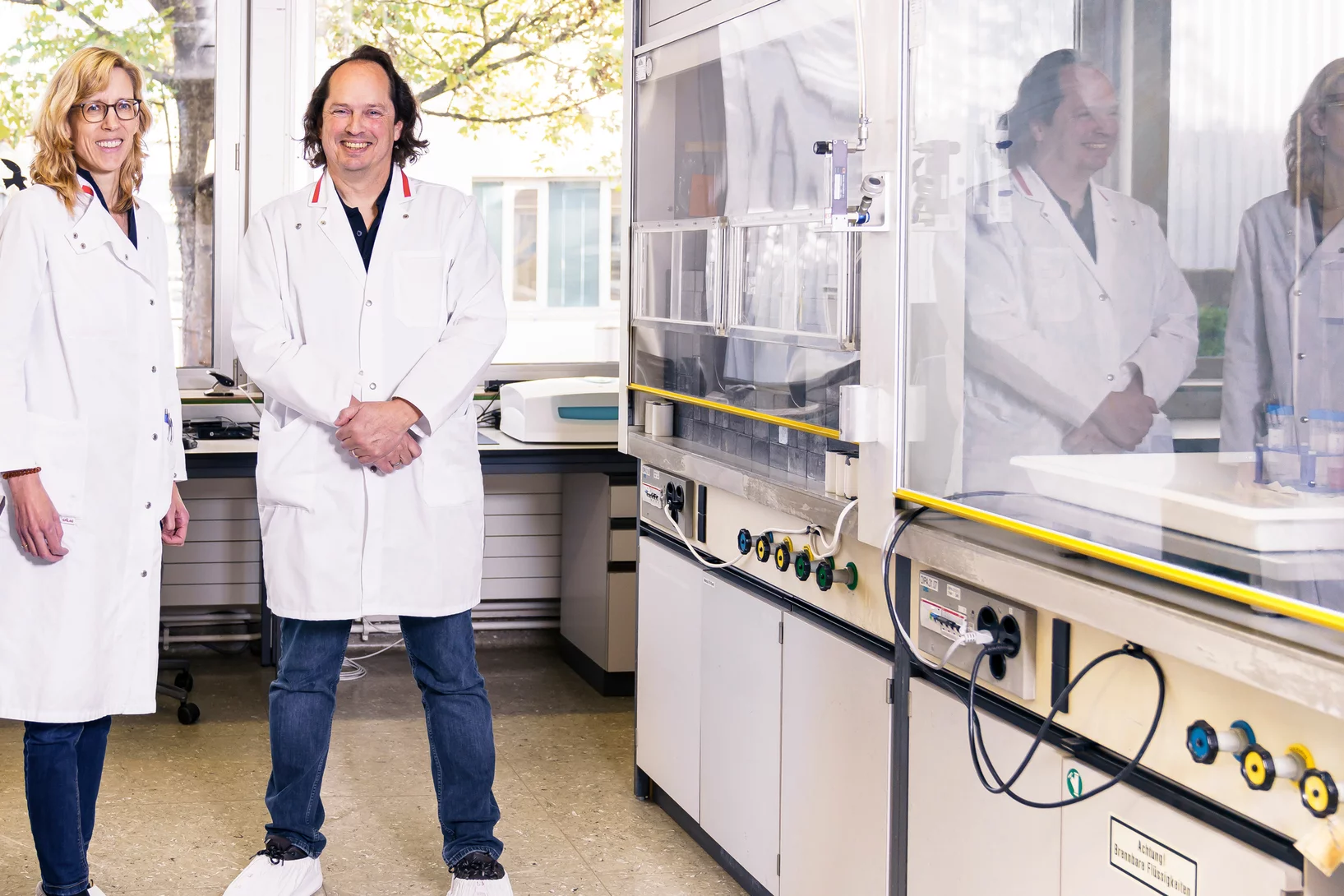
President Parmelin has approved the funding application of a large consortium led by the Paul Scherrer Institute PSI and the University of Zurich. With the National Centre of Competence in Research (NCCR) Muoniverse, muon research at PSI will be equipped for the future to address research questions from science and industry. A lighthouse project with international prominence.
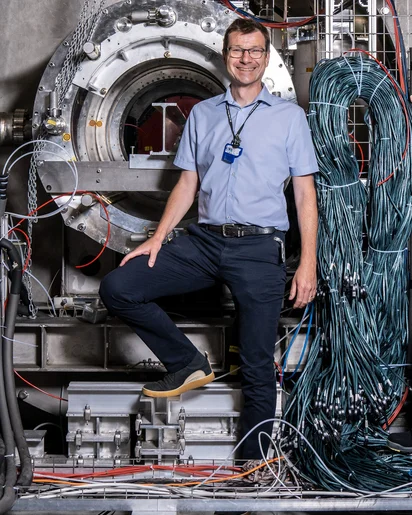
Klaus Kirch is head of the Laboratory for Particle Physics in the PSI Center for Neutron and Muon Sciences and a professor at ETH Zurich. He is director of the now-approved NCCR Muoniverse. © Paul Scherrer Institute PSI/Markus Fischer
For the sixth time, the Swiss National Science Foundation (SNSF) has launched a funding round for National Centres of Competence in Research (NCCRs). The SNSF supports long-term research projects of strategic importance in which participating researchers collaborate across disciplinary and institutional boundaries to address key topics. The Paul Scherrer Institute PSI, together with the University of Zurich (UZH), has been awarded the contract for the NCCR named Muoniverse. As the name suggests, the project focuses on research with elementary particles called muons.
“We are very pleased to be leading an NCCR with our Muoniverse project,” says Klaus Kirch. He is head of the Laboratory for Particle Physics at the PSI Center for Neutron and Muon Research, a professor at ETH Zurich and the designated director of Muoniverse. Series of NCCRs were previously launched in 2001, 2005, 2010, 2014 and 2020. PSI has contributed to several of these, including MaNEP, MUST and MARVEL. Now, for the first time, PSI is leading an NCCR.
The deputy director is Angela Papa, also a researcher in the PSI Center for Neutron and Muon Research. “Today at PSI, we possess the facility with the most intense muon beams worldwide, which enables us to conduct unique research,” she explains. This makes PSI an important hub for researchers around the world in particle physics as well as in materials research – especially for magnetic, quantum, and energy materials. In the future, the facility will be able to do significantly more, thereby opening up internationally unique possibilities for existing and future research activities.
Muons: Electrons’ heavy siblings
Muons are elementary particles and, so to speak, the heavy siblings of electrons and their antiparticles, positrons. They possess physical properties identical to those of electrons and positrons, differing only in that they have considerably more mass and are unstable. Their greater mass allows them to penetrate much more deeply into materials. “This is a major advantage because muons can be used to examine thick material samples, while with electrons you only see the surface layers,” Kirch explains, highlighting the advantages of muon research. However, muons are also very short-lived, which is why sophisticated particle accelerators are needed to produce them and deliver them quickly to the experiment before they decay.
The current facility at PSI does deliver intense muon beams. “But the competition is catching up, and that’s why we are currently upgrading our facilities through a project named IMPACT,” the physicist explains. But this will not exhaust the potential of muon research, not by a long shot. Therefore the researchers are planning a whole series of improvements with Muoniverse that go far beyond the current state of the art. “We are entering uncharted technological territory in several respects,” says Kirch.
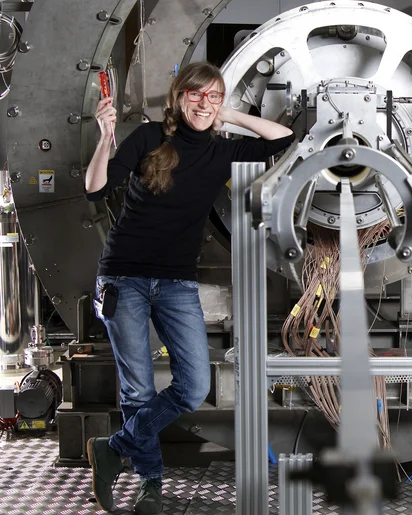
Angela Papa is a researcher in the PSI Center for Neutron and Muon Sciences, a professor at the University of Pisa (Italy) and deputy director of the NCCR Muoniverse. © Paul Scherrer Institute PSI/Markus Fischer
From axe to scalpel
Muoniverse will open up unique research opportunities. The usable muon beams will be focused much more precisely. “In the future, thanks to the higher beam quality, we will be able to carry out highly precise analyses even on small material samples,” the researcher emphasises, adding with a smile: “We're essentially turning the axe into a scalpel.” Such clean muon beams will not only allow for the detailed analysis of novel quantum materials or superconductors. Muon beams should also become interesting for industry, for example to investigate charging and discharging processes in batteries.
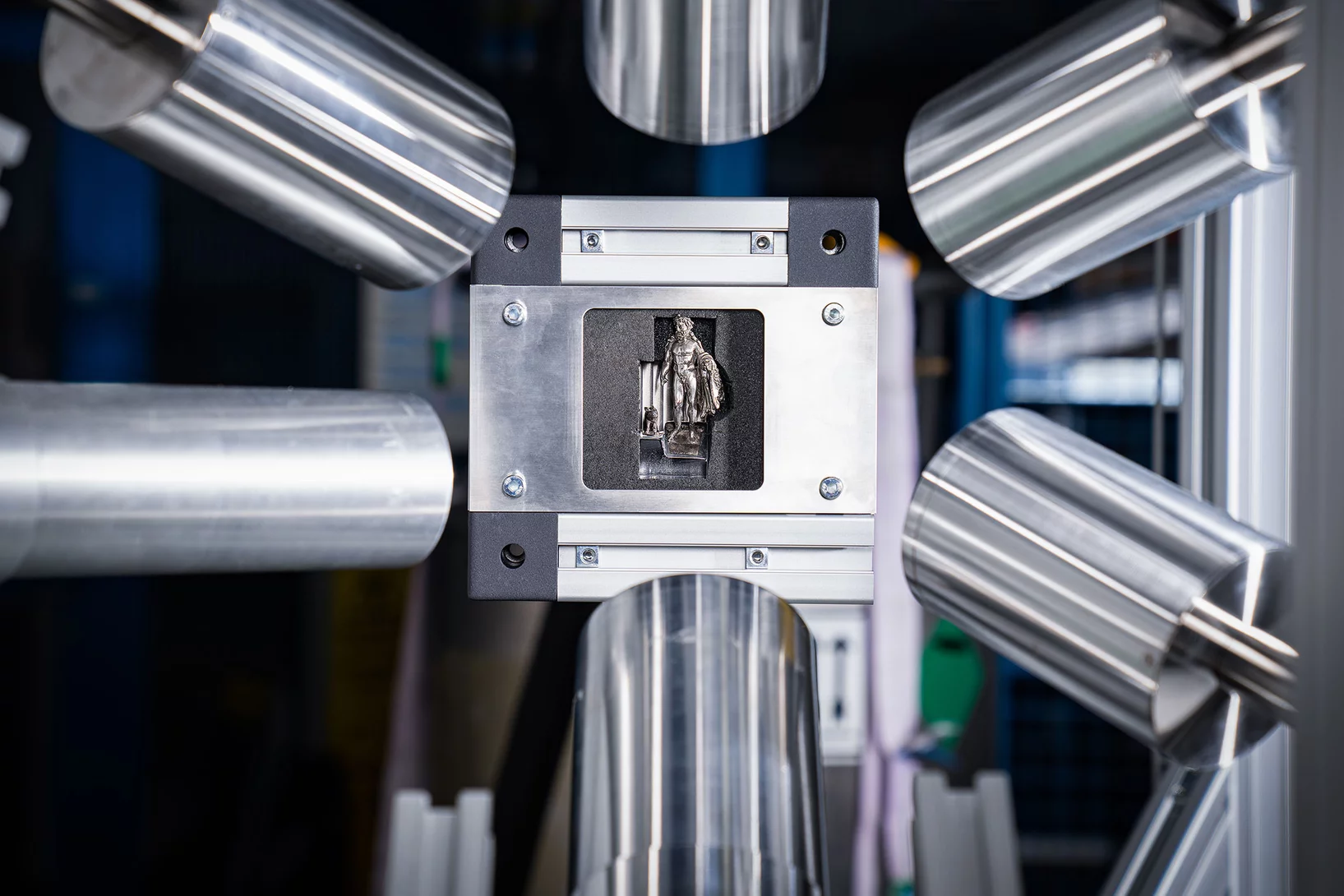
Even art history and archaeology will have access to entirely new opportunities, including the non-destructive examination of objects, paintings and artifacts. This could allow researchers to determine their elemental composition, uncover hidden layers, detect forgeries or even date the creation of a work of art. For that reason, the Swiss National Museum and Augusta Raurica are among the project partners.
Muoniverse is a large collaboration comprising, in addition to PSI as project leader and the University of Zurich as co-leader, a number of other partners: the Universities of Bern, Fribourg, and Geneva; ETH Zurich; EPFL Lausanne; Lucerne University of Applied Sciences and Arts; the "artists-in-labs" art project of the Zurich University of the Arts; Empa; the Swiss National Museum; Augusta Raurica; the WSL Institute for Snow and Avalanche Research SLF; and CERN. Several other prestigious international institutes are also part of this extended research network.
“Jointly with the University of Zurich, we will create three new professorships within the framework of Muoniverse,” says Marc Janoschek, head of the PSI Center for Neutron and Muon Sciences, professor at the University of Zurich and co-director of Muoniverse. “This will allow us to sustainably anchor the interdisciplinary topics of this NCCR in Switzerland.”
Contact
Further Information
About PSI
The Paul Scherrer Institute PSI develops, builds and operates large, complex research facilities and makes them available to the national and international research community. The institute's own key research priorities are in the fields of future technologies, energy and climate, health innovation and fundamentals of nature. PSI is committed to the training of future generations. Therefore about one quarter of our staff are post-docs, post-graduates or apprentices. Altogether PSI employs 2300 people, thus being the largest research institute in Switzerland. The annual budget amounts to approximately CHF 450 million. PSI is part of the ETH Domain, with the other members being the two Swiss Federal Institutes of Technology, ETH Zurich and EPFL Lausanne, as well as Eawag (Swiss Federal Institute of Aquatic Science and Technology), Empa (Swiss Federal Laboratories for Materials Science and Technology) and WSL (Swiss Federal Institute for Forest, Snow and Landscape Research). (Last updated in June 2025)