In 1999, a cancer patient received intensity-modulated proton therapy (IMPT) at PSI – a world first. The technique helped make spot-scanning proton therapy a huge success in the treatment of cancer, and established it as a universal standard. This modern form of proton radiotherapy was developed at PSI.
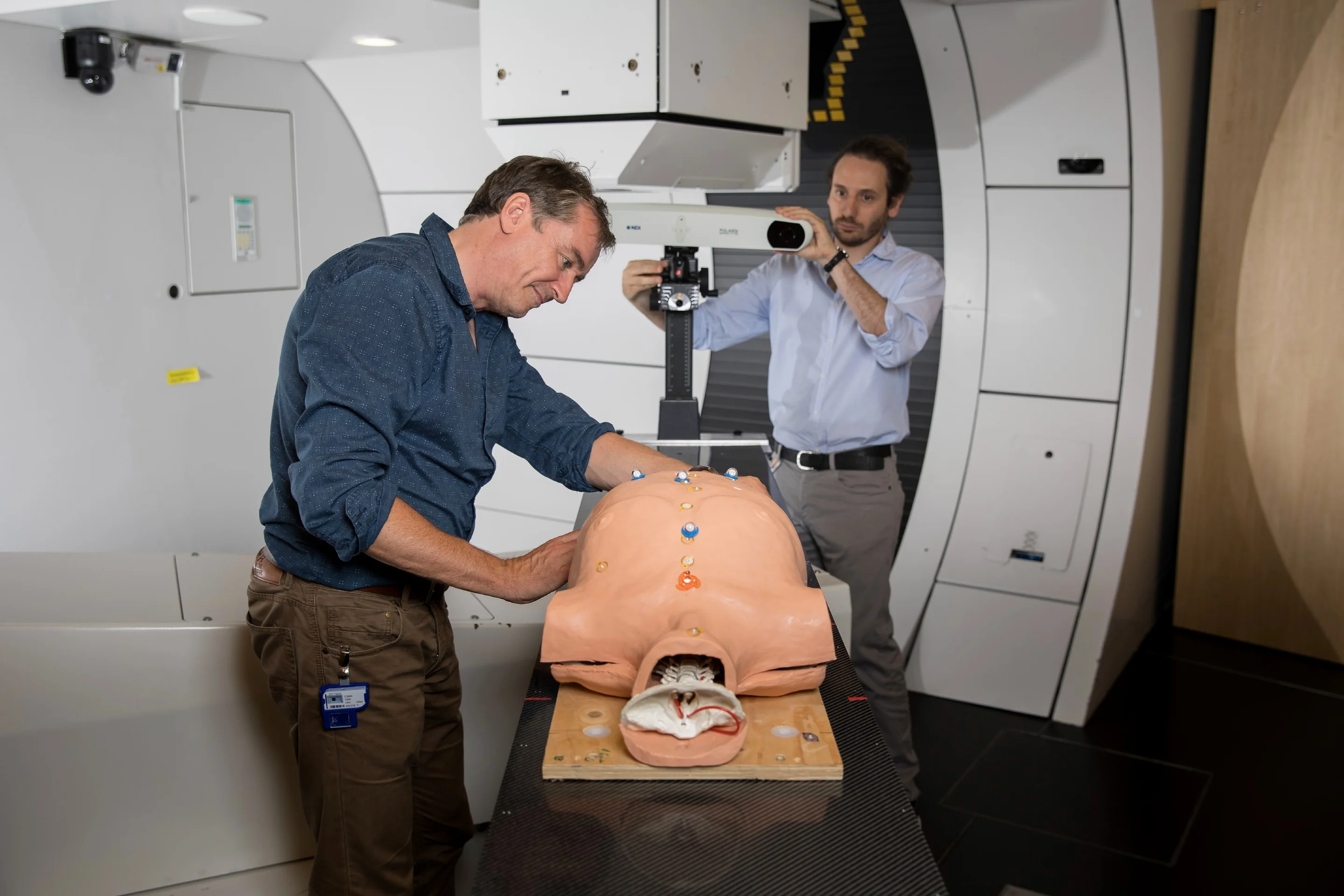
Listening to Tony Lomax, you can immediately tell that he was in fact born in the English city of Manchester. But his English accent doesn’t slow him down in the least as he tells his story in German – no wonder, after spending more than three decades in Switzerland. “When I arrived at PSI as a postdoc, it was pervaded by a pioneering spirit,” the medical physicist recalls fondly. A small team of very talented physicists and medical scientists were working on irradiating deep-seated tumours with protons.
This was a new idea; until then, cancer patients had been treated using X-rays – the conventional radiotherapy that is still primarily used today. However, protons, being charged particles, can also kill cancer cells. And they have a major advantage: they release most of their energy inside the tumour, leaving the surrounding healthy tissue unharmed.
In the 1990s, proton therapy went from being an interesting idea to a practical technique that could be used successfully in human beings. Thanks to the major technological breakthroughs that took place at the time, we now have a further modern tool in the targeted fight against cancer. Whereas the world’s first proton therapy facilities were using “passive scattering” to treat patients, the researchers at PSI wanted to go further and developed the spot-scanning method – a pioneering advance which became a major clinical success.
The enduring success of spot-scanning proton therapy continues to this day, but it was only made possible by another technique, which was developed by Tony Lomax and his team: IMPT or intensity-modulated proton therapy. This technique allows proton therapy to target tumours with even greater precision, thereby affording even greater protection to sensitive organs during radiotherapy.
The pioneering spirit of the 1990s
Tony Lomax joined PSI in 1992 to help develop the spot-scanning method. In this technique, a pencil-thin beam of protons scans deep-seated tumours spot by spot in three dimensions, destroying them in the process. At the time, the global community had substantial doubts as to whether such an approach could ever be implemented safely. Thanks to Eros Pedroni, Hans Blattmann and Gudrun Goitein, this method was developed to a point where PSI was able to use it successfully on a patient for the first time in 1996.
After its début in 1996, some very good results were achieved on a few dozen patients using spot scanning. But Tony Lomax continued to tinker around, seeking to perfect the treatment planning system – the software that controls how much proton radiation hits the tumour and from which direction.
Patients receiving proton therapy lie on a table while the machine, called a gantry, rotates around them. This means that the proton beam strikes the tumour from different directions. The trick used in intensity-modulated proton therapy is to produce proton beams with non-uniform fields that enter the patient’s body from different directions. These fields combine at the target site, the tumour, which then receives the necessary dose of protons at a uniform level, destroying it.
Lomax uses his hands to demonstrate the idea. Spreading his fingers, he says: “My hands are now the field, in other words the proton radiation.” The fingers are spread apart, indicating that the field is not homogeneous. The amount of radiation is greater along the fingers than between them. But when he brings his hands together so that the spread fingers are alongside each other, they form a uniform surface. Before radiotherapy is carried out, the computer calculates how best to accomplish this interaction.
Successful across the board
Intensity-modulated proton therapy manipulates the pencil beams used in spot scanning such that tumours are irradiated layer by layer. That involves adjusting the number of protons, the energy of the beam and the magnetic deflection, among other things. This affects the depth to which the beam penetrates the body and the radiation dose that arrives at the tumour.
“Spot scanning with IMPT brings out the best in the protons,” says Tony Lomax. Its development has made treatment planning more flexible – quite simply, there are more different ways of irradiating a tumour. It also makes it easier to deal with anatomical idiosyncrasies, for example when sensitive organs are “in the way” during radiotherapy. This reduces the overall exposure of healthy tissue.
In the autumn of 1999, the time had come. The first patient received radiotherapy using a combination of spot scanning and IMPT. The 34-year-old male had a chondrosarcoma, a malignant tumour of the bone, in the thoracic spine – a challenge for performing radiotherapy. Using IMPT meant that the heart, lungs and healthy spine could be exposed to as little radiation as possible. The risk of side effects or even long-term damage from radiotherapy was reduced. The treatment was successfully completed on 12 November 1999.
A boost for proton therapy
“When I first presented IMPT at a conference in 1999, everyone said: Wow!” Tony Lomax recalls. “Suddenly, people realised what could be achieved with spot scanning.” Today, all modern proton therapy centres around the world use intensity-modulated proton therapy. The technology also ensured that proton therapy would become the success story it is today. “The added flexibility provided by IMPT has shown the world the enormous potential of spot-scanning proton therapy.” It is only thanks to IMPT that this form of cancer treatment achieved its clinical breakthrough.
Tony Lomax drew his inspiration from intensity-modulated radiotherapy (IMRT), the analogous technique applied to X-rays in conventional radiotherapy – which had been developed by Thomas Bortfeld at the University of Heidelberg, among others, with whom Tony Lomax consulted closely at the time. IMRT, too, aimed to irradiate tumours more precisely while sparing healthy tissue.
The time was ripe
Today Tony Lomax heads the Physics Research Section at the Centre for Proton Therapy. In the international scientific community of proton therapy Tony Lomax is renowned for the development of IMPT. In 2024, the Particle Therapy Co-Operative Group (PTCOG) presented him with the Robert R. Wilson Award in recognition of his life’s work to date. In addition to his work at PSI, Tony Lomax is a titular professor at ETH Zurich, is actively involved in teaching and has already supervised more than 25 PhD students.
The breakthrough in proton therapy that Tony Lomax and his team achieved was only possible because he was in the right place at the right time, he says. “I arrived at PSI just as spot-scanning proton therapy was being developed there and shortly before it became a success. I also joined an extremely capable team and was able to build upon the work my predecessor had already begun.” Not to forget, intensity-modulated proton therapy called for a great deal of computing power, and information technology had only just reached this point. In short, “20 years earlier, IMPT simply wouldn’t have been possible.”
Text: Brigitte Osterath