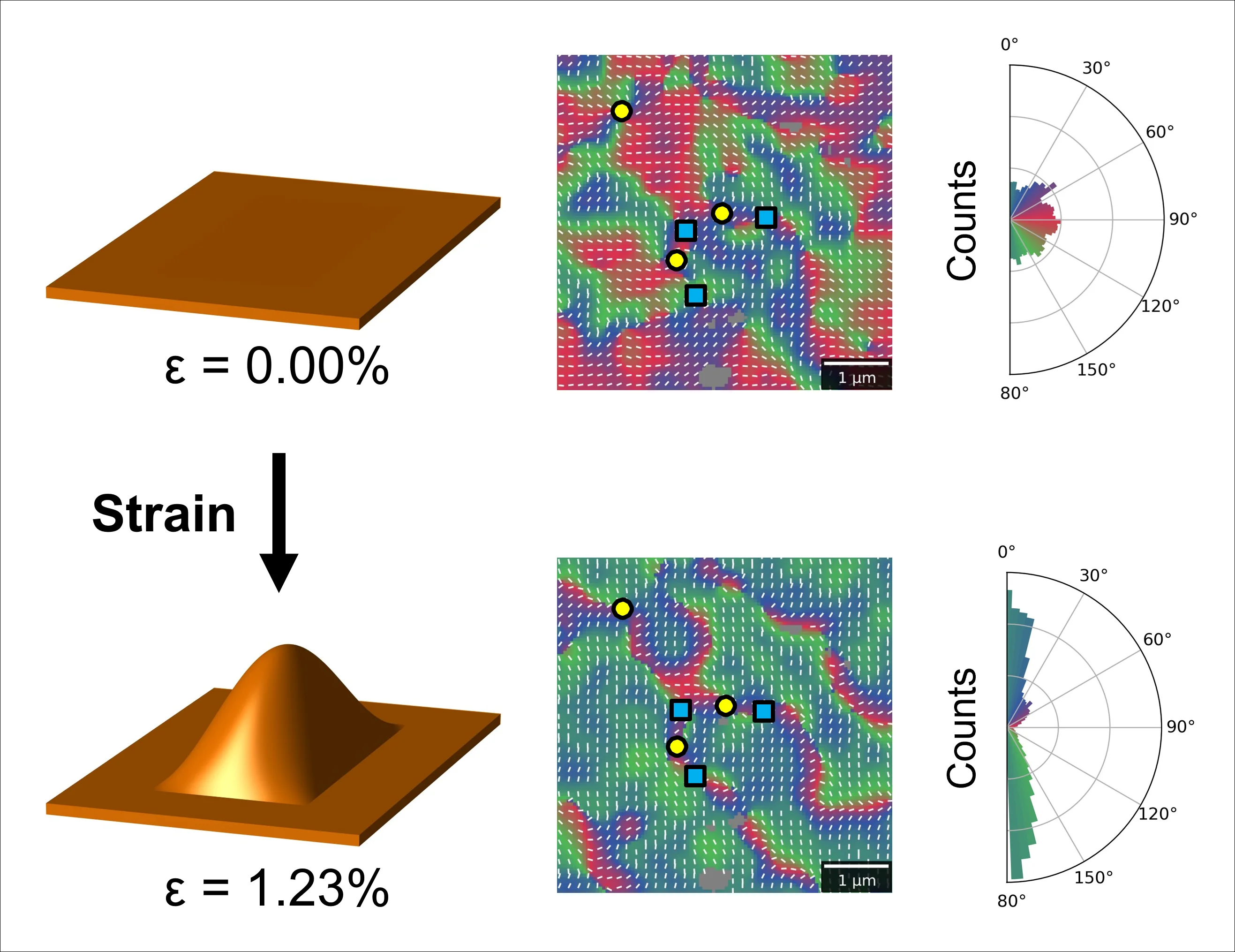
Researchers from the University of Oxford have collaborated with the Microspectroscopy group at PSI to design a simple and effective way to control magnetism at the nanoscale, opening a new route to engineering advanced materials for next-generation low-energy technologies. In a study published in ACS Nano, the Oxford team tackled this challenge by demonstrating that the key to this control lies not in magnetic fields but in something far simpler: strain. They worked with free-standing membranes of the classic antiferromagnet hematite (α-Fe₂O₃) – the purest form of iron oxide in rust – that are highly flexible and can be bent by over 1000x their thickness. By bending the membranes to apply controlled in-plane strains, they discovered that they could reconfigure the magnetic order at room temperature with remarkable precision.
Using high-resolution X-ray microscopy at the PolLux and SIM beamlines of the Swiss Light Source, the team directly observed how the magnetic domains evolved as the membranes were gently stretched. The stretching was performed using a custom gas cell setup designed at PSI. They found that controlled strain provides a clean and reversible way to reconfigure the material’s magnetic state. Importantly, topological features such as merons and antimerons, which are whirling magnetic “tornadoes”, remained stable even under large deformations, showing that strain can reshape the magnetic landscape without damaging these structures — a key requirement for future devices.
Contacts:
Dr. Jack Harrison
Swiss Light Source
Paul Scherrer Institut
Telephone: +41 56 310 4570
E-mail: jack.harrison@psi.ch
Dr. Jörg Raabe
Swiss Light Source
Paul Scherrer Institut
Telephone: +41 56 310 5193
E-mail: joerg.raabe@psi.ch
Original Press Release:
Engineering magnetic states for future devices | University of Oxford Department of Physics
Original Publication:
Room Temperature Control of Axial and Basal Antiferromagnetic Anisotropies Using Strain
Jack Harrison, Junxiong Hu, Charles Godfrey, Jheng-Cyuan Lin, Tim A. Butcher, Jörg Raabe, Simone Finizio, Hariom Jani, and Paolo G. Radaelli
ACS Nano 19, 50, 42118–42127 (2025), DOI:10.1021/acsnano.5c12282