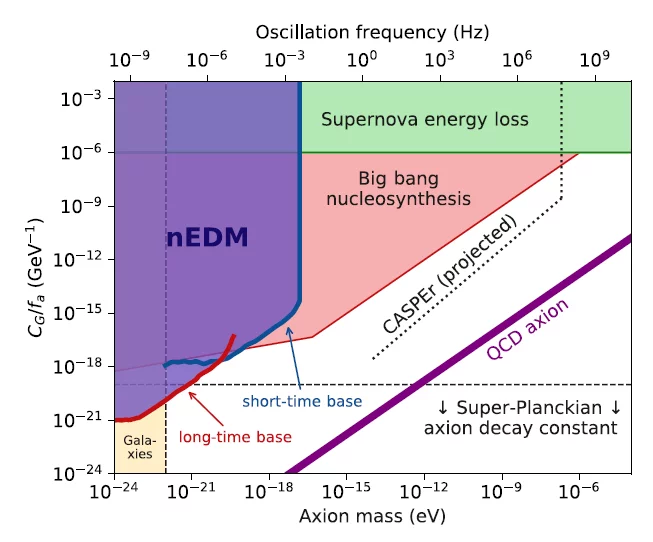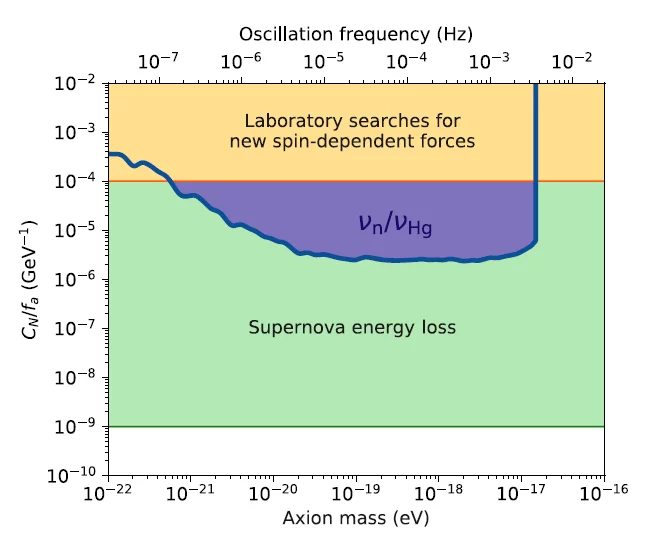

The nEDM apparatus at PSI is also an excellent tool to search for signatures of dark matter particles (Roccia S, Zsigmond G, 2021). A potential signal is a shift in the ratio of the spin-precession frequencies of ultracold neutrons (UCN) and the 199Hg atoms of the co-magnetometer. This shift can be interpreted as caused by a possible short-range spin-dependent neutron–nucleon interaction mediated by axion-like particles and was studied with high precision (Figure 1, Afach et al. 2015). In a second effort, the aforementioned ratios measured during the nEDM data-taking were analyzed as an axion-induced oscillating electric dipole moment of the neutron, and as an axion-wind spin-precession effect (Figures 2 and 3, Abel et al. 2017).
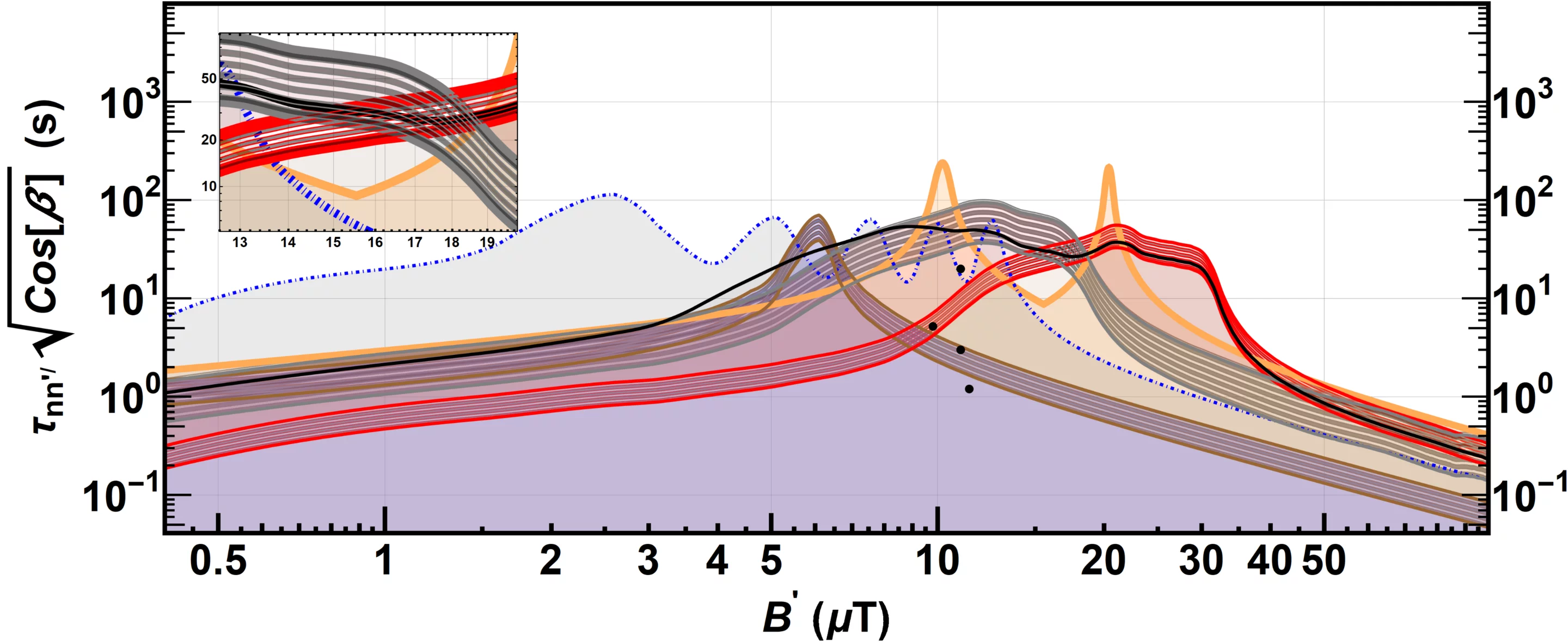
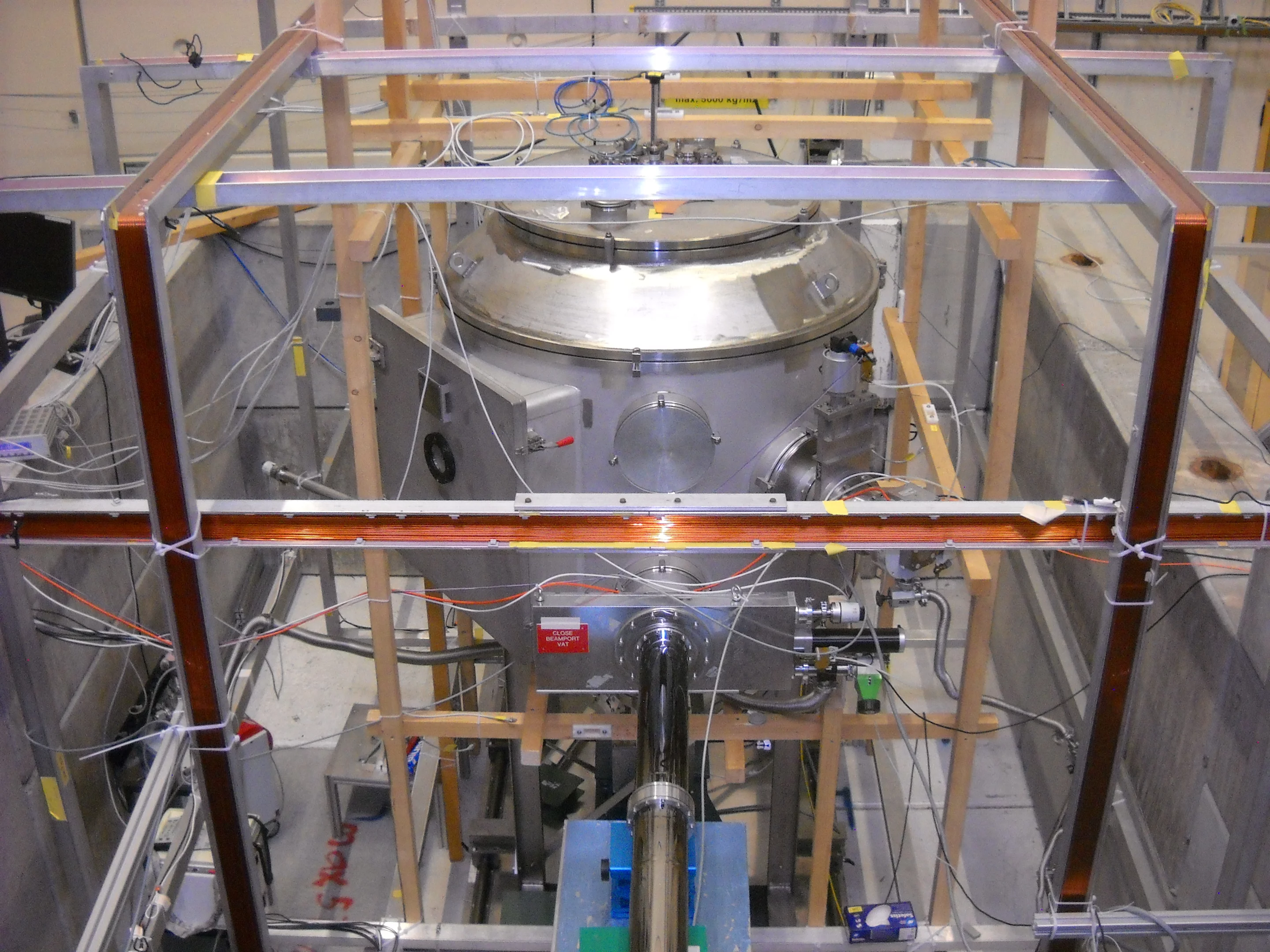
So-called disappearance experiments, which can also be conducted with UCNs, are a further way to search for dark matter signatures. It was hypothesized in the fifties by Lee and Young that there could be a mirror copy of the weakly interacting particles, restoring parity conservation on the global level. Since then, various theorists put forward the idea that oscillations between a neutral SM particle, such as the neutron, and its mirror counterpart could help to explain various issues in physics, including dark matter. Various searches for oscillations of neutrons to mirror-neutrons were conducted using the nEDM apparatus. Limits were achieved for the cases of zero mirror-magnetic field (Ban et al. 2007) and of assuming non-zero mirror magnetic fields (Altarev et al. 2009) originating from mirror photons. Recent reports of anomalous signals sparked world-wide attention and initiated further search at PSI yielding new limits (Figure 4, Abel et al. 2020). A new dedicated apparatus has been installed at beamport West-1 to continue this effort, see Figure 5. and Ref. N. J. Ayres et al. 2022, with final results published in N. J. Ayres et al. 2026, PRL (Figure 6.) and N. J. Ayres et al. 2026, PRD (Figure 7.).