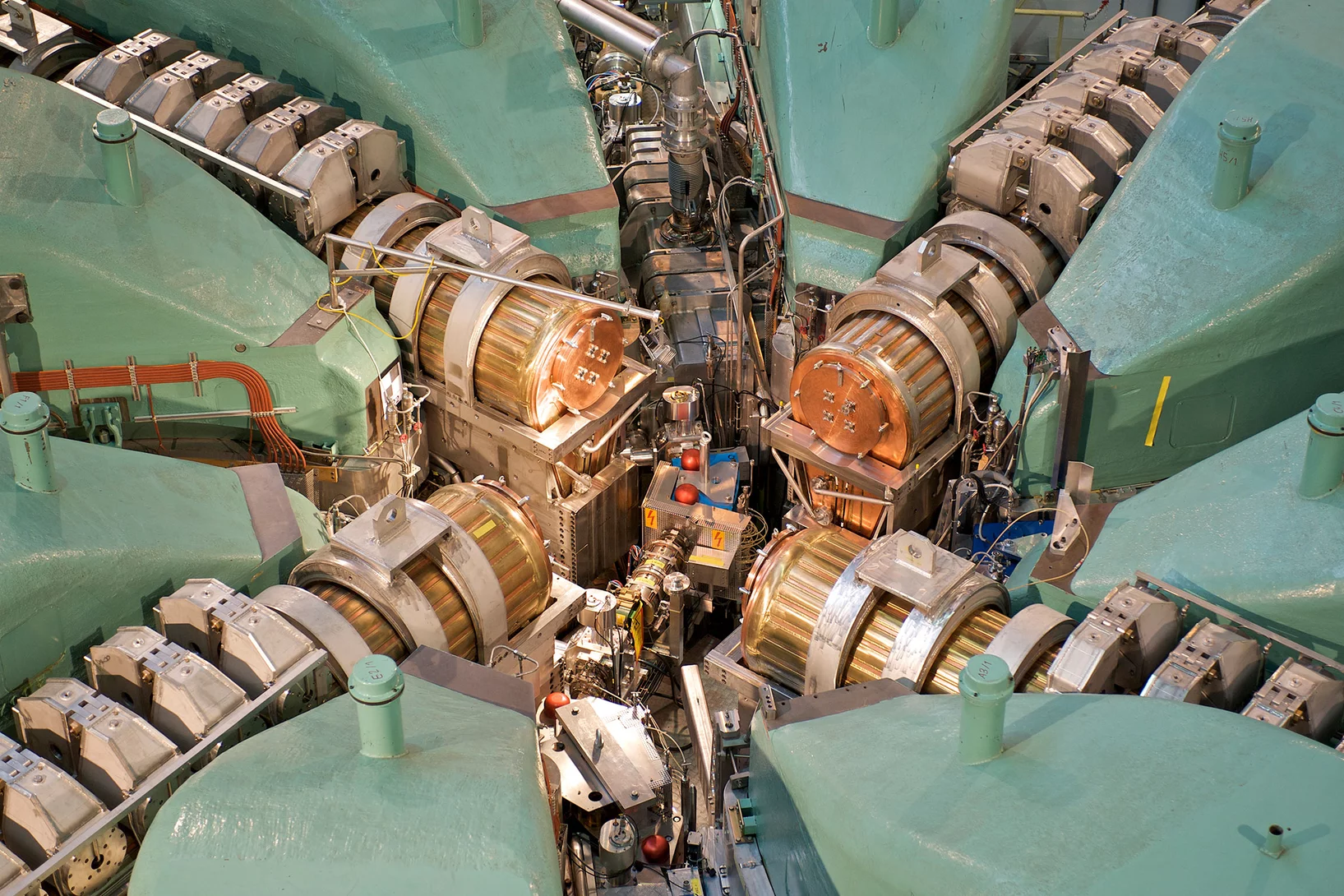

Photoemission electron microscope (ES1)
| Spatial resolution | down to ~50 nm depending on sample |
|---|---|
| Electron energy resolution | 0.2 eV |
| Sample temperature | 50 K < T < 1'800 K |
| Field of view | 5 - 150 μm diameter |
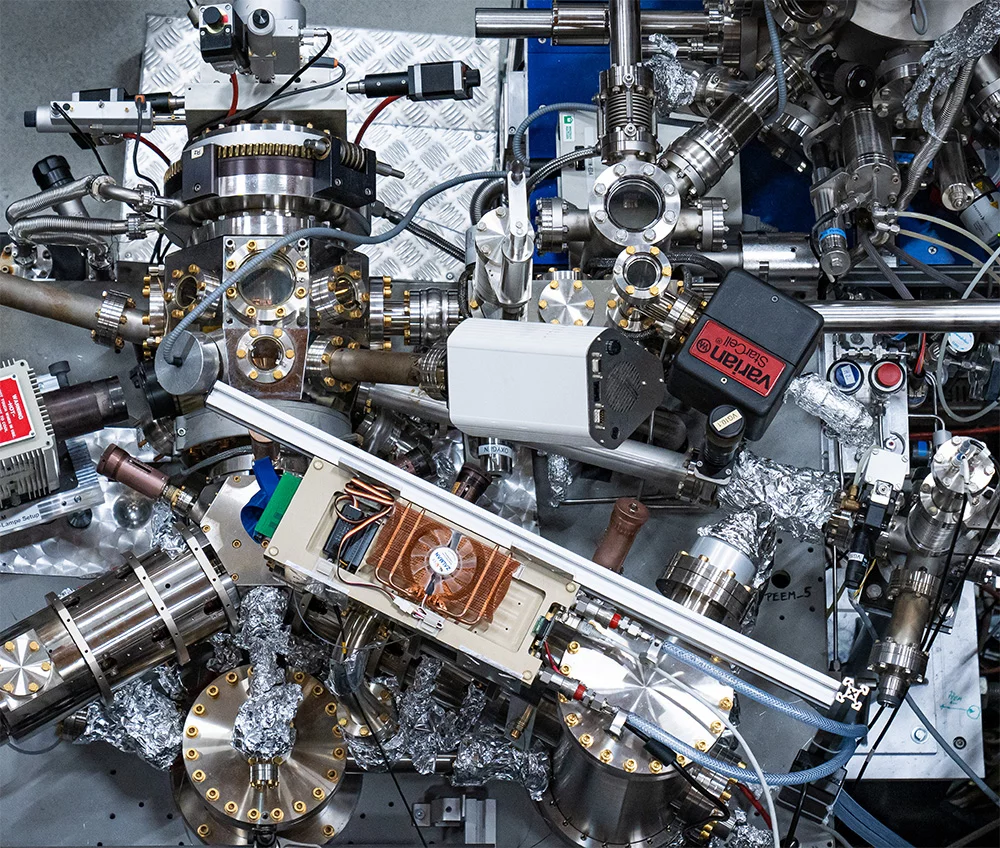
The permanent endstation of the SIM beamline is a Photoemission Electron microscope (PEEM) (Model: SPELEEM, Elmitec GmbH) with a motorized and rotatable sample stage. It allows one to image samples using the photoelectric effect with very high spatial resolution. With an additional energy analyzer these photoelectrons are then energy-selected. In addition to the grazing incidence X-ray illumination (16°), the sample can be illuminated by low energy electrons. In this low energy electron microscopy (LEEM) mode, additional contrast mechanisms are available. The PEEM is equipped with a small preparation chamber (sputtering, heating, load-lock), while a larger preparation system equipped with LEED and e-beam evaporators, is also available.
When the sample is retracted, the light passes through the PEEM and can be used in a second endstation further downstream either focussed or unfocussed.
Sample Conditions in PEEM
PEEM is a surface sensitive technique. Its depth of view is limited by the inelastic mean free path of the photoelectrons which is typically ~5 nm. The PEEM operates in UHV and with a high voltage (Va = 10-20 kV) to accelerate the excited photoelectrons into the microscope lenses to produce a magnified image of the intensity of the locally emitted electrons.
For successful imaging in the PEEM the sample should meet the following conditions:
- sample dimensions: diameter < 10 mm, thickness ~0.1-3 mm
- UHV compatible (p < 10-8 mbar)
- flat and conducting surfaces are likely to produce high quality images with good spatial resolution.
For more information please contact the beamline scientist (Carlos Vaz or Armin Kleibert).
MultiXAS (ES2) (under commission).
| Scientific applications | Spectroscopy of electronic, chemical, and magnetic properties of advanced materials. |
|---|---|
| Experimental techniques | XAS, XMCD, XMLD |
| Characteristics | UHV chamber with external electromagnet. |
| Detection modes | Total electron yield (TEY), total fluorescence yield (TFY) |
| Spot size at the sample | ~0.3 mm x 1.5 mm (H x V) |
| Sample requirements | Solid samples, up to 10 x 10 mm2 (surface area) and max. thickness of 1 mm. |
| Sample preparation | None |
| Sample environment | UHV Temperature range: 10 K to 400 K. Temperature controlled heating. |
| Magnetic field | Dipolar electromagnet: ± 130 mT . Magnetic field/photon helicity switching within 1-2 s. Possibility to do time-resolved polarization measurements. |
SOPHIE (ES4)
A soft x-ray ptychography microscope (SOPHIE) operated by the Microspectroscopy Group enabling high spatial resolution (~5 nm) soft x-ray spectromicroscopy.
Call schedule
| Call for proposals I-27 | |
|---|---|
| Experimental Period | I-27 |
| Call | 01 September 2026 |
| Submission deadline | 15 October 2026 (midnight, 23:59 CEST) |
| Start period | 01 March 2027 |
| End period | 31 August 2027 |
| Notification of outcome | December 2026 / January 2027 |