

Prof. Dr. Martin Fertl from the Johannes Gutenberg University Mainz (JGU) and the PRISMA+ Cluster of Excellence has been awarded an ERC Consolidator Grant, one of the EU's most highly endowed grants, to support the development of the next-generation neutron lifetime experiment, anticipated to be located at the Paul-Scherrer-Institute’s source for ultracold neutrons (UCNs).
The fundamental levels of nature are highly successfully described by the Standard Model of Particle Physics. But despite its success, there are also several mysteries, such as discrepancies between different measurements or discrepancies between experimental results and theoretical predictions. These mysteries show that the Standard Model does not yet tell the whole story and provide initial clues to "new physics" beyond the Standard Model. One such mystery is the lifetime of the neutron.
Precision measurements provide a powerful approach to search for physics beyond the Standard Model. To confirm that, for example, deviations between measurements do not have an experimental origin, the properties of Nature must be observed with the highest precision and accuracy. This is for example possible at PSI’s world leading sources of intense muon and neutron beams.
Neutrons provide an ideal testing ground to investigate the weak interaction decay of the simplest neutral hadron, by measuring e.g. their free beta-decay lifetime and the angular correlations between the spin of the neutrons and/or the direction of the emerging decay products.
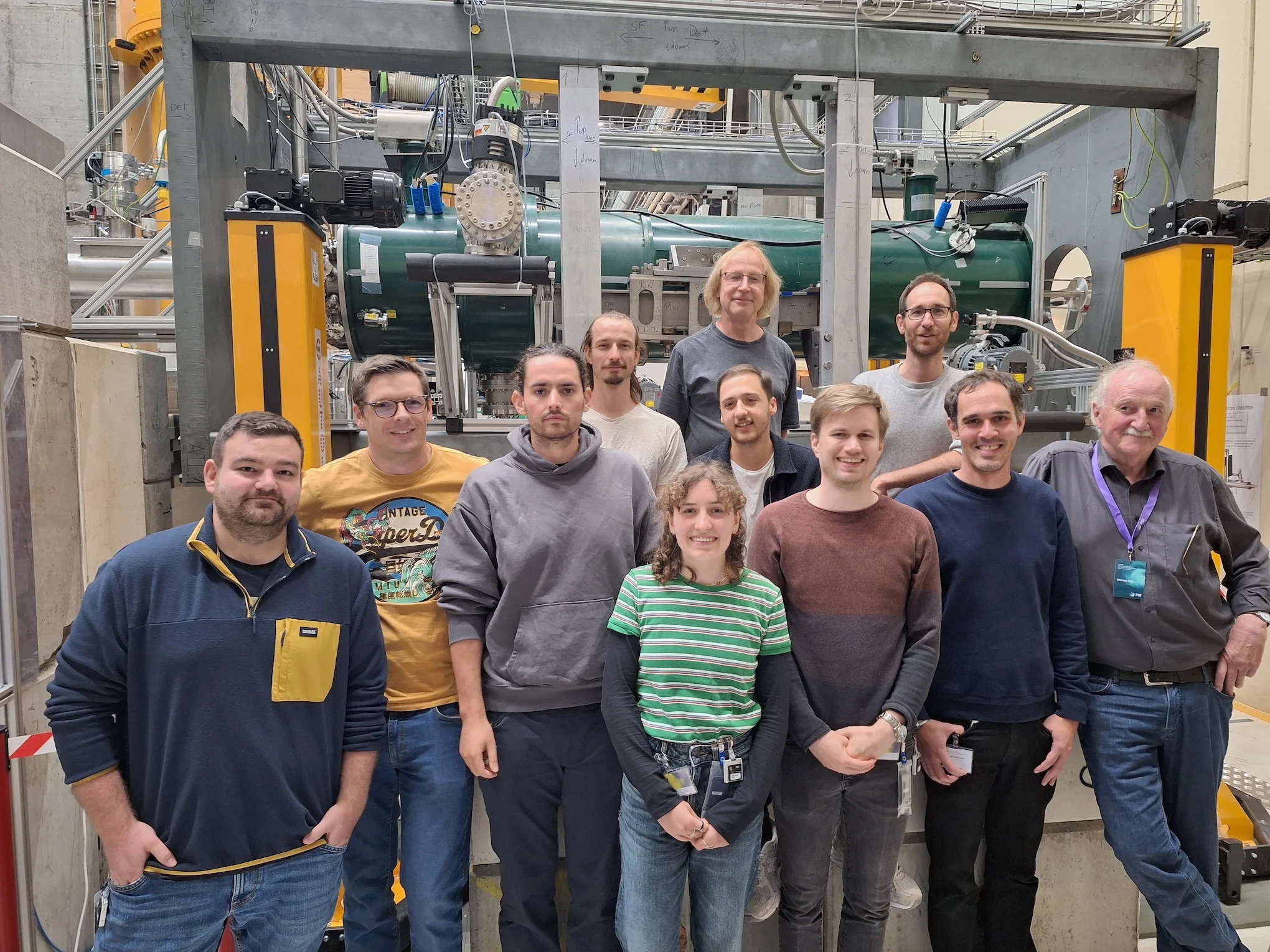
In summer 2023, the 𝜏SPECT experiment, which was developed in Mainz, was transported to PSI. It has been in operation ever since to determine the free neutron lifetime. Within the experimental setup, the UCNs delivered from the PSI UCN source are spin polarized. This process makes one spin state trappable in a volume surrounded by a strong magnetic field gradient. Once an UCN arrives at the edge of the trap its spin is manipulated using strong radio-frequency fields to confine the UCNs in their trap. The first successful demonstration of this so-called spin-flip loading scheme for a magnetic trap was reported in [1].
After different preset holding times, a detector is inserted into the trap to count the number of remaining UCNs. From the measured time dependence, the lifetime of the free neutron can be extracted. The fully magnetic walls suppress neutron losses on material surfaces that could bias the extracted value of the neutron lifetime. The statistical precision of such a counting experiment depends on the number of detected UCNs at the end of the storage period. The ongoing 𝜏SPECT experiment re-uses the superconducting magnet of a previous neutron decay correlation experiment. In this setup, due to e.g. spatial constraints, only a small fraction of the UCNs delivered from the PSI UCN source can be loaded into the magnetic trap.
The aim of the NuLife project is to develop an experimental setup that can accommodate a much larger fraction of the UCN phase space delivered at the beam port West 1, with improved control over systematic bias effects. The novel apparatus τSPECT2 shall provide a much deeper and much larger trap, so that many more UCNs can be confined in every fill cycle. Within NuLife a setup combining a groundbreaking superconducting trap with innovative beamline concepts, shall be developed to dramatically increase the number of observed UCNs. “Based on an extrapolation from previous experiments at PSI, the successful implementation of NuLife could increase the number of neutrons stored in the τSPECT2 experiment by up to 200 compared to our prototype τSPECT setup. The developments in NuLife shall ultimately open the door towards a determination of the neutron lifetime with an uncertainty of less than 0.1 s.”
The development of a fully magnetic trap for UCNs, on which the NuLife project is based, was initiated at JGU already more than a decade ago by Fertl’s predecessor, Prof. Dr. Werner Heil."Since I joined JGU in 2019, I contributed my decisive ideas, on whose successful demonstration the NuLife project is now based. I co-lead the τSPECT experiment with Dr. Dieter Ries, who is a tenure track scientist at PSI,” says Fertl.
The NuLife project aims to fully translate the outstanding performance of the τSPECT experiment and the PSI UCN source into unprecedented experimental precision for the determination of the neutron lifetime, a corner stone reference point of the Standard Model of Particle Physics.
[1] J. Auler et al, J. Phys. G: Nucl. Part. Phys. 51, 115103 (2024)