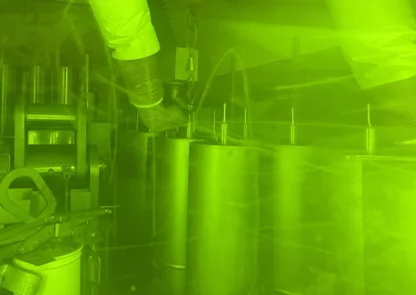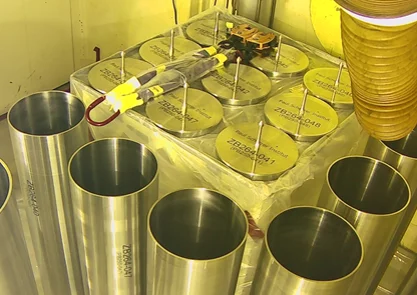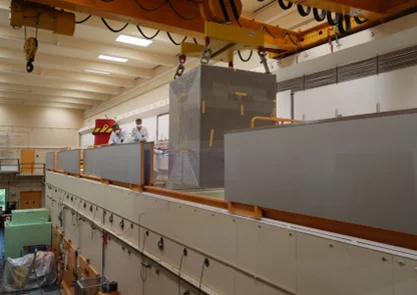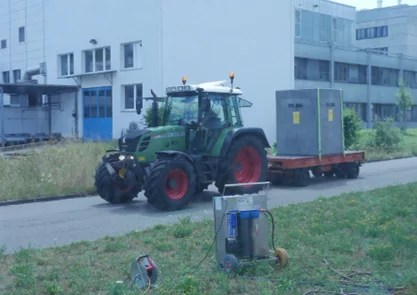
Several PB250 compactor containers were conditioned as part of the type testing for waste container type 11 (AGT-11). This included dose rate measurements of the waste packages, gamma scans, comprehensive documentation, sealing the containers in contamination-free ZB264 auxiliary containers, loading these containers into a type 12 small container (KC-T12), and then transferring them to the federal interim storage facility (BZL).
Design and manufacture of additional equipment
Various technical devices also had to be newly developed and manufactured for the conditioning process:
- Filling device for filling the PB250 with mortar
- Welding system for sealing the heavily contaminated PB250 in the hot cell into the contamination-free ZB264 outer container
- Inner container for the KC-T12, which ensures reliable shielding and fixation of the waste packages. This means that the contents remain protected and can be recovered undamaged even in the event of a potential crash of the KC-T12.
Accompanying inspections by the authorities
The type testing was closely monitored by the competent authorities and checked in several inspections. The focus was particularly on documentation, welding of the containers, quality testing, and loading of the KC-T12.
Acknowledgments and outlook
NRM would like to express its sincere thanks to the hot cell group, radiation protection, and AERA for their excellent cooperation throughout the entire testing process.
The next step will be to revise the relevant documents based on the findings and then submit them to ENSI together with the application for approval of the AGT11. We are confident that we will receive approval in the coming year and will be able to transfer the conditioning to routine operation.