


Gotthard-I
Gotthard-I is a 1D detector system based on the principle of charge integration with automatic gain switching capability. The goal of the project is to provide a 1D detector that can sustain the instantaneous many-photon deposition typical of the forthcoming XFEL machines retaining at the same time the same data quality of a single photon counting detector. Due to some unique features like the high frame rate (40kHz continuous and up to 1MHz in bursts) the low noise and the spectral information availability the detector opens new possibilities in synchrotron source applications.
The module architecture

The detector module is composed from 10 readout ASIC (Application Specific Integrated Circuit) wire bonded to a single silicon sensor with a 4mm x 8mm sensitive area for a total of 1280 channels at 50 um pitch. A complete readout chain, from the high speed ADCs to the Gbit link for the data download, is also integrated on the board. The control of the detector is performed via an ethernet linkt to the onboard Blackfin-based Linux system. High voltage for the sensor and all powers are locally generated from a common 5V input supply.
Results and Specifications


Gotthard-II
Gotthard-II is a charge-integrating microstrip detector developed for hard X-ray experiments at Free-Electron Lasers (FELs), in particular for the European X-ray Free-Electron Laser (EuXFEL) in Schenefeld. Gotthard-II is the most widely employed detector for energy dispersive experiments well suited to the 1-D geometry at the EuXFEL. It is capable of taking images at 4.5 MHz frame rate for all the 2700 pulses in the EuXFEL bunch train when operating in burst mode; in addition, Gotthard-II can be operated in continuous mode as well for experiments at synchrotron radiation sources, which enables continuous imaging at a maximal frame rate of ~ 410 kHz without a stop.
The architecture of the Gotthard-II detector
The Gotthard-II detector uses a silicon microstrip sensor with a pitch of 50 um or 25 um and with 1280 or 2560 channels wire-bonded to 10 or 20 readout ASICs respectively. The thickness of the silicon sensor is either 320 um or 450 um. The readout ASIC is designed using charge-sensitive, dymamic gain switching pre-amplifier similar to Gotthard-I and JUNGFRAU. In the ASIC, on-chip analogue-to-digital converters (ADCs) and SRAMs have been implemented for the fast analogue signal conversion and on-chip temporal storage. The readout ASIC is fabricated using UMC-110 nm technology.

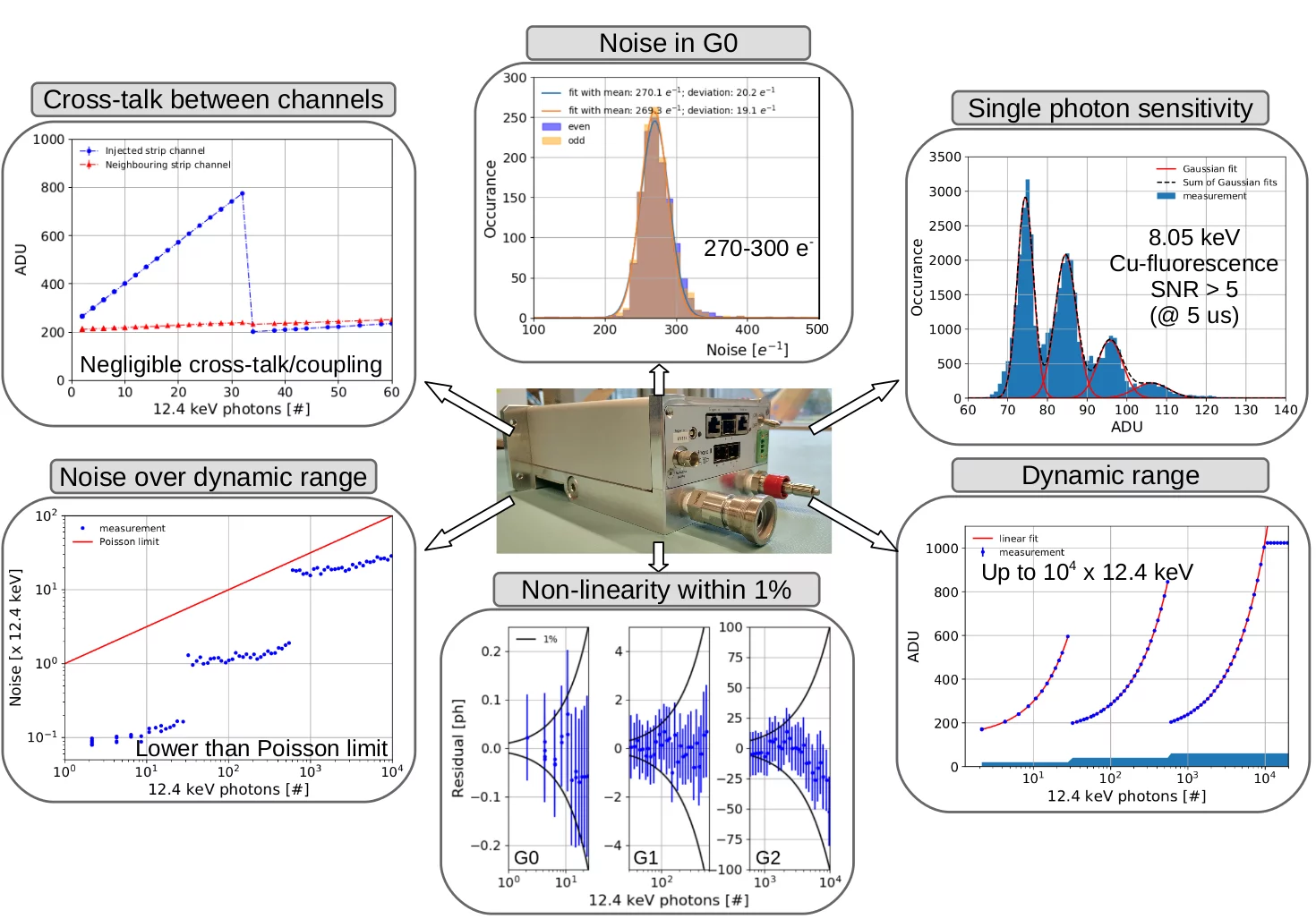
Results and specifications
Applications

XFELS
- X-ray emission spectroscopy (XES) using bending crystals
- X-ray powder diffraction
- X-ray beam diagnostic (XPD): shot to shot spectral information with energy dispersive optics, beam position and intensity monitor
- X-ray pulse arrival monitors (PAMs)
Synchrotron sources
- pump-probe experiments
- X-ray emission and energy-dispersive X-ray spectroscopy (XES and EDXAS)
- diffraction experiments at very high photon rates
- high resolution applications (a smaller pitch sensor is used)
Documentation
| GOTTHARD 1.0, 50 um | |
| GOTTHARD 1.0, 25 um |
*Please refer the latest installation section for instructions on the latest software package.
Publications
Team
| Person | Position | Phone Nr. | |
|---|---|---|---|
| Dr. Aldo Mozzanica | Detector Scientist
|
||
| Dr. Jiaguo Zhang | Scientist
|