

Show filters

Deep geological disposal of radioactive waste in clay rocks
Geological waste disposal, cement clay interaction
• A considerable reduction of HTO and 36Cl− was observed after 6 years interaction.
• The chloride flux showed a much stronger reduction compared to HTO.
• For HTO the relation between the De and the porosity in the clay part can be described using Archie's law.
• No complete clogging of the porosity was observed after 6 years interaction.

Sorption of trivalent lanthanides and actinides onto montmorillonite
The credibility of long-term safety assessments of radioactive waste repositories may be greatly enhanced by a molecular level understanding of the sorption processes onto individual minerals present in the near- and far-fields. A study conducted at LES in collaboration with the Helmholtz Zentrum Dresden Rossendorf used extended X-ray absorption fine structure (EXAFS) and time-resolved laser fluorescence spectroscopies (TRLFS) to elucidate the uptake mechanism of trivalent lanthanides and actinides (Ln/AnIII) by the clay mineral montmorillonite.The excellent agreement between the thermodynamic model parameters obtained by fitting the macroscopic data, and the spectroscopically identified mechanisms, demonstrates the mature state of the 2SPNE SC/CE sorption model developed at LES for predicting and quantifying the retention of Ln/AnIII elements by montmorillonite-rich clay rocks.
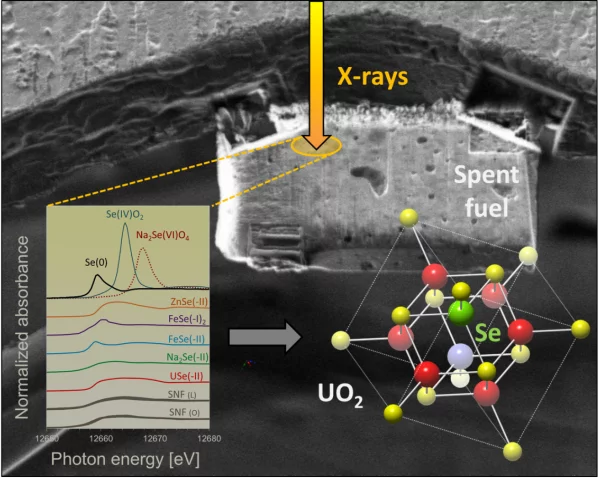
The chemical state of 79Se in spent nuclear fuel
An interdisciplinary study conducted at different PSI laboratories (LES, AHL, LRS, SYN) in collaboration with Studsvik AB (Sweden) demonstrates that selenium originating from fission in light water reactors is tightly bound in the crystal lattice of UO2. This finding has positive consequences for the safety assessment of high-level radioactive waste repository planned in Switzerland, as it implies (contrary to previous assumptions) that the safety-relevant radionuclide 79Se will be released at extremely low rates during aqueous corrosion of the waste in a deep-seated repository.

Porträt Jenna Poonoosamy: Die Vermesserin der Gesteinsporen
Drei Jahre in Folge hat Jenna Poonoosamy den Preis für die beste Präsentation am Doktorandentag im Bereich Nukleare Energie und Sicherheit (NES) am Paul Scherrer Institut PSI erhalten. Poonoosamy stammt ursprünglich von der Insel Mauritius im Indischen Ozean. Schon in der Schule interessierte sie sich vor allem für Chemie. «Die meisten meiner Freunde wollten in die Wirtschaft», erzählt sie. «Mich dagegen haben die Naturwissenschaften fasziniert.» Und so zog sie nach der Schule zum Chemie-Studium nach Paris. Und kam später für ihre Doktorarbeit ans PSI.

Endlagersuche: Viele 100'000 Jahre sicher im Ton
Obwohl die Schweiz aus der Kernenergie aussteigt, muss sie eine Lösung für das in den Kernkraftwerken, aber auch in Medizin, Industrie und Forschung entstandene, radioaktive Material finden. Daher stellt sie sich einer aussergewöhnlichen, verantwortungsvollen Aufgabe: Sie sucht einen Ort, an dem sie ihre radioaktiven Abfälle mehrere hunderttausend Jahre lang sicher lagern kann. So lange, bis sie von selbst die Radioaktivität natürlicher Gesteine erreicht haben.
Structure of concrete disease
solved
When bridges, dam walls and other structures made of concrete are streaked with dark cracks after a few decades, the culprit is the so-called the concrete disease. Researchers from the Paul Scherrer Institute PSI and Empa have now solved the structure of the material produced in these cracks at atomic level - and have thereby discovered a previously unknown crystalline arrangement of the atoms.
Radioactive waste caught in a cement trap
In a deep geological repository, low and intermediate level radioactive waste from nuclear applications is solidified by cementitious materials for several thousand years. Researchers from the Paul Scherrer Institute and the Karlsruhe Institute of Technology have now demonstrated how cement limits the mobility of those radioactive substances. The new findings improve our understanding of the processes involved in this early phase of deep geological disposal.

Keeping geothermal energy on the table
A study by the Centre for Technology Assessment TA-Swiss, coordinated by the Paul Scherrer Institute, recommends further pursuing deep geothermal energy in Switzerland. The energy resources underground are vast, environmentally friendly to extract and available around the clock, the authors conclude. The earthquake risk and the cost of electricity production, which are still too high, however, remain challenges that society needs to weigh up against the advantages of deep geothermal energy.
Clay remains clay: how radionuclides sorb to the host rock in repositories
Researchers from the Paul Scherrer Institute (PSI) and the Hungarian Academy of Sciences joined forces within an EU project to investigate the basic properties of argillaceous rocks in a repository for high-level radioactive waste. As the results reveal, the insights gained so far for Opalinus Clay can be transferred also to the Boda Clay found in Hungary.