Beamline Overview
S-TOMCAT (X02DA)
S‑TOMCAT is optimized for fast and flexible 3D X‑ray imaging, enabling both real‑time studies of dynamic processes and high‑quality scans of large samples. Utilizing the high brilliance of the SLS synchrotron source, the beamline supports absorption‑based imaging as well as multiple phase‑contrast modalities, providing excellent sensitivity to subtle structural variations.
Key capabilities include:
- Voxel sizes: 0.16–11 µm
- Energy range: 8–80 keV, plus high‑flux white beam from a 5 T superconducting bend
- Beam size: up to 50 mm horizontally
- Phase‑contrast modes: propagation-based imaging and grating interferometry
NOTE: Monochromatic operation is currently restricted to 8-30 keV and up to a FOV of 1.5 mm.
I-TOMCAT (X02SA)
Researchers requiring nanometer‑scale spatial resolution and time‑resolved X‑ray imaging in the micrometer scale can rely on I‑TOMCAT as an advanced platform for high‑performance synchrotron tomography. Powered by a U15 undulator—with a planned upgrade to a HTSU10 in 2027—the beamline provides the coherence and photon flux needed for demanding experimental workflows.
What it offers:
- Voxel sizes from 50 nm to 1.1 µm
- Monochromatic energy range of 8 to 50 keV
- Three dedicated endstations designed for high‑resolution, high‑throughput, and dynamic imaging
NOTE: Recommended energy range 8-30 keV till HTSU10 upgrade in 2027.
Research Applications
- Life sciences: imaging tissues, organs, and plant structures
- Materials science: microstructure characterization and defect analysis
- Geosciences: porosity, mineralogy, and fluid‑transport studies
- Engineering: additive manufacturing, quality assessment, and failure analysis
- Cultural heritage: non‑destructive examination of fossils and artifacts
- Energy research: degradation and microstructure evolution in batteries, fuel cells, and related materials
Location and Floorplan
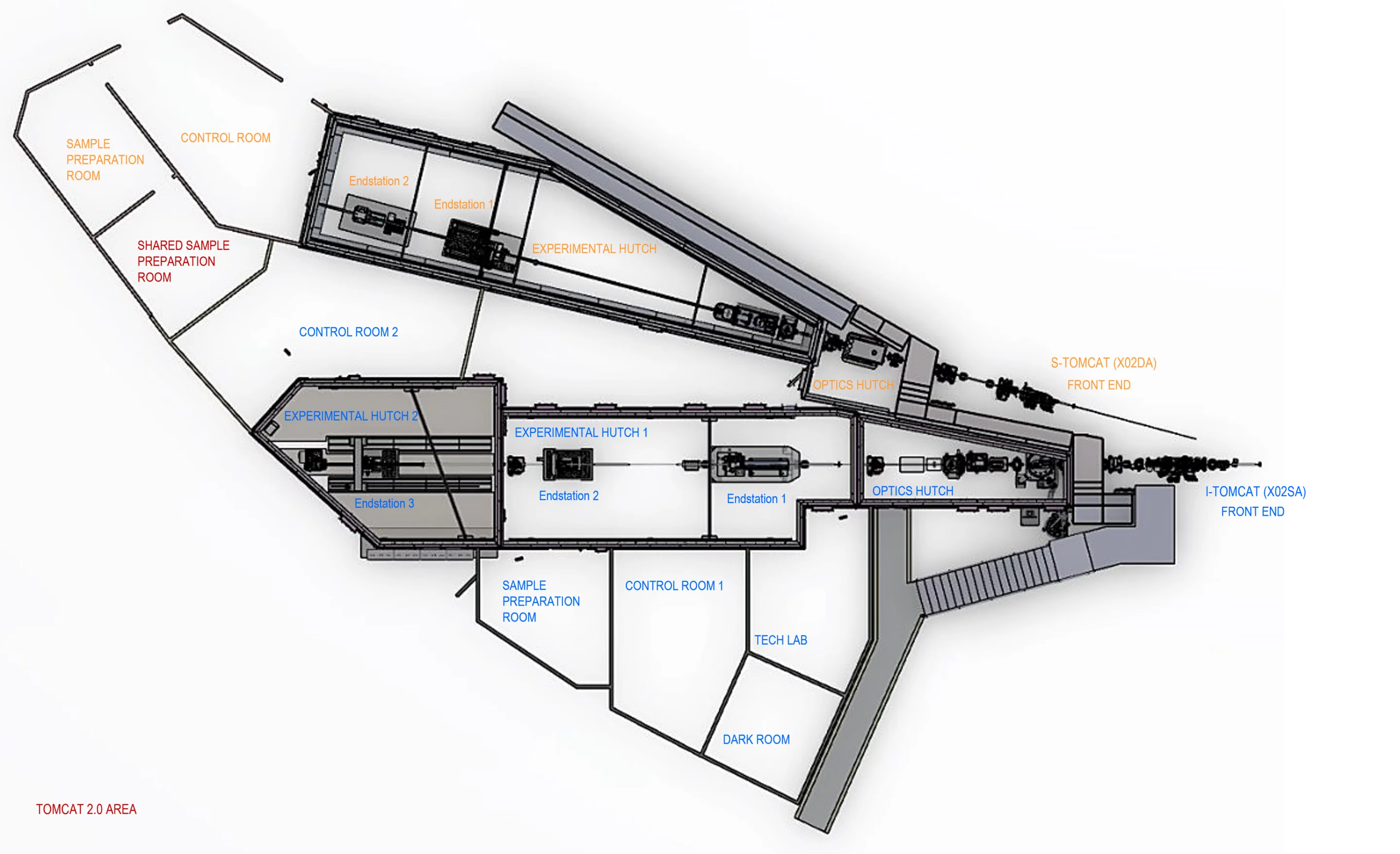
The S‑TOMCAT and I‑TOMCAT beamlines are located in the experimental area of the Swiss Light Source, between sectors 27 and 32. This part of the SLS hall brings together state‑of‑the‑art instrumentation, dedicated preparation spaces, and easy access for users.
S‑TOMCAT features a spacious 17‑meter experimental hutch that hosts two endstations. Adjacent to the control room, users will find both a basic sample preparation room and a versatile multi‑purpose laboratory, the latter shared with I‑TOMCAT to support more advanced experiment needs.
I‑TOMCAT includes two experimental hutches housing three cutting‑edge endstations tailored to high‑resolution, high‑throughput, and dynamic imaging. Each hutch is served by its own dedicated control room, providing an efficient and comfortable working environment during experiments.
For biological and sensitive sample handling, a Bio‑Lab equipped with a laminar‑flow hood allows for safe and controlled sample preparation on site.