
Optical elements
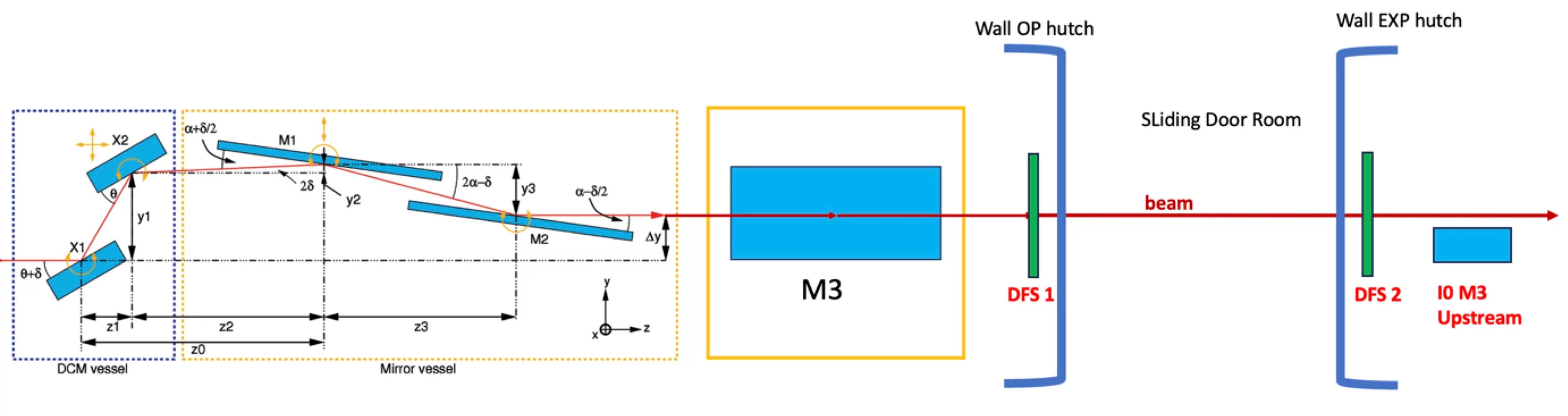
A document describing the optics geometry for the new setup for undulator radiation is described here. An important change has been effectuated in coincidence with the SLS2.0 ring upgrade. A third vertical mirror has been added in 2023 just before the start of the shutdown for the SLS2.0 upgrade. This mirror provides a very precise and reproducible horizontal focusing of the beam, that is significantly improved with respec to the formerly used option of sagittally focusing by bending the second crystal, especially as reproducibility and preserved monochromaticity, at the cost of a small side deviation (0.1 deg) of the beam path. The stations have al been realigned on the new position of the beam, that coincidentally was also displaced by a few cm because of the SLS2.0 ring upgrade.

The optical elements of the beamline and their functions are listed here.
| Element | Function | Distance from source [m] |
|---|---|---|
| High Power Slits | Beam defining | 11.662 |
| SiC BPM | Permanent beam position monitor | 12.44 |
| Filter | Beam attenuation | 17.806 |
| Optics slits | Beam definition | 18.27 |
| XBPM1 | Beam position monitoring | 18.341 |
| First LN2 cooled DCM crystal | Monochromatization | 18.758 |
| Second DCM crystal | Monochromatization | 18.8-19.1 |
| XBPM2 | Beam position monitoring | 19.306 |
| Mirror 1 | Vertical collimation | 20.13 |
| Mirror 2 | Vertical focussing | 20.83 |
| Mirror 3 (vertical) | Horizontal focussing | 22.23 |
| CVD screen 1 | Beam imaging and position monitor | 23.053 |
| XBPM3 | Beam position monitoring | 23.326 |
| Station shutter | Extinction of experimental beam | 23.772 |
| Bremsstrahlung blocker | Blocking of direct beam and BS | 30.485 |
| 1D diffractometer | Experiment | 32.79684 |
| 2D optical table | Experiment | 33 - 37 |
| 3D diffractometer | Experiment | 40.0865 |
| Fixed XRE at rear wall | Beam shaping | 43.28 |

Double-crystal monochromator
The double crystal monochromator (DCM) consists of two Si 111 crystals which are precisely positioned and oriented in the X-ray beam.


Two successive Bragg reflections, with an inherent energy resolution of 0.014 %, together with two mirrors, direct photons of the desired energy parallel to the incoming beam direction, but offset upward (out of the direct Bremsstrahlung beam) by 20 mm. Changes in photon energy require changes in the mirror angles and the vertical position of the first one, and of course in the horizontal and vertical position of the second DCM crystal.
The outgoing beam is shifted up by 20 mm compared to the incoming beam. See Table below for the motor functions.
| EPICS channel | Description |
|---|---|
| First crystal | |
| MOX1:ROX | rotation (pitch) of the first crystal stages around X axis |
| MOX1:ROY | rotation (roll) of the first crystal stages around Y axis |
| MOX1:TRY | translation of 1st crystal stage |
| Second crystal | |
| MOX2:ROX | fine adjustment of Bragg angle of 2nd crystal |
| MOX2:ROY | roll of 2nd crystal |
| MOX2:ROZ | yaw of 2nd crystal |
| MOX2:TRX | yaw of second crystal around its normal |
| MOX2:TRY | vertical movement |
| MOX2:TRZ | horizontal translation of 2nd crystal |
| MOX2:TRYA...D | flexing of 2nd crystal to produce sagittal (horizontal) focussing |
Mirrors

The beamline optics are shown above. The first mirror (MI1) provides vertical collimation and removes high-order harmonics. The second mirror (MI2) is similar to MI1. A variable curvature of MI2 permits vertical focusing at the experimental station in use. Each mirrors consists of a 40cm long Si block, with triple switchable Si-Rh-Pt coating (for energy ranges 5-10 keV, 8-22 keV, 20-40 keV, respectively). They are both automatically tilted to direct the beam along the proper vertical path to the sample position(s). The second can also be bent (5 < R < 30 km) as required for the desired beam focus (spot vertical size down to a few 0.01mm, depending on energy). The surface of the mirrors is polished to a rms roughness < 0.5 nm. The vertical focusing provided by the second mirror is easily adjusted and perfectly reproducible.
Horizontal (sagittal) focussing
The horizontal focussin function has been devolved to the newly installed mirror 3 (vertical), that shows the same excellent performance in precision and reproducibility as the vertically focussing by mirror 2.

Last revision A. Cervellino, May 2026