

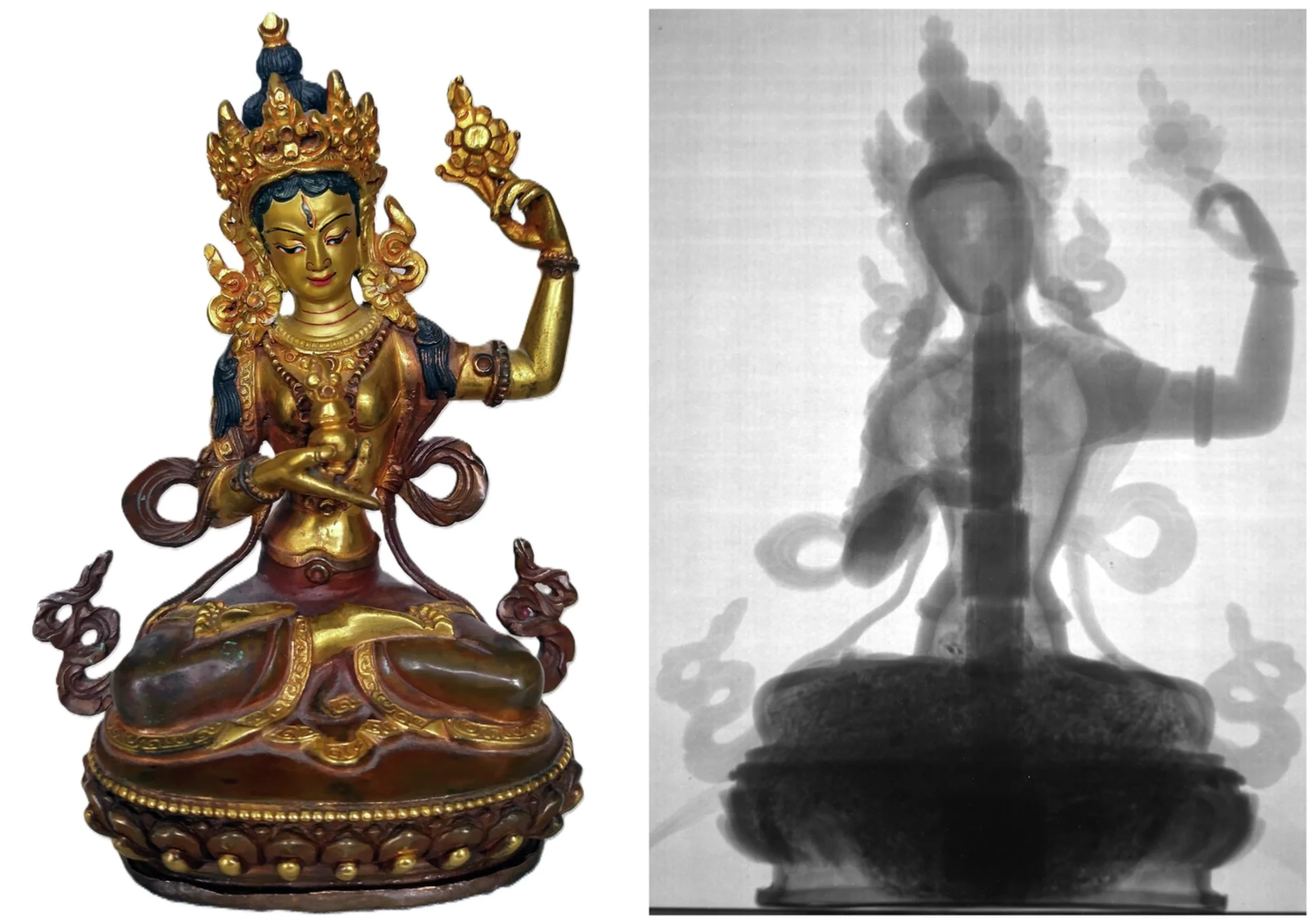
Bronze statues hold deep significance in Buddhism and Bon, often containing relics sealed within their hollow interiors. Traditional scholarly methods, such iconographic analysis, cannot access the hidden contents of these statues without risking physical damage. This study proposes neutron imaging as a non-destructive alternative.
Unlike X-rays, neutrons can effectively penetrate metal and enhance the visibility of organic materials, making them particularly ideal for detecting relics inside bronzes. Through three case studies, including one contemporary Bon bronze statue and two ancient Buddhist bronze statues, previously inaccessible internal features are revealed. Advanced visualisation tools are integrated into this work to render these elements with greater clarity. Drawing on these visualisations, an in-depth analysis of the historical and religious context in which each statue was created is presented. These findings highlight both the capabilities and current limitations of neutron imaging for cultural heritage studies and serve as a model for future investigations.
Facility: SINQ
Reference: E. Frame et al, npj Heritage Science 14, 38 (2026)
Read full article: here