The Thin Films and Interfaces Group
Thin films are nowadays utilized in many applications, ranging from semiconductor devices to optical coatings and are even present in pharmaceuticals (polymers). This wide-spread application of films with thicknesses from atomic monolayers to microns is due to the developments of thin film deposition techniques. Thin films are also important for studies of materials with new and unique properties due to the possibility of tuning their crystallographic and morphological properties. The thin film approach, i.e. the presence of interfaces (to a substrate or the film surface) adds more degrees of freedom for influencing the properties of materials, e.g. by lattice strain or surface functionalization. For these fundamental studies of material properties large research facilities such as synchrotron radiation or neutron spallation sources are one of the keys that the Paul Scherrer Institute (PSI) provides.
News

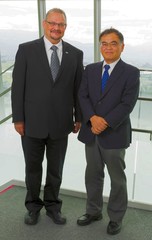
Appointment of Thomas Lippert as new head of the Laboratory for Multiscale Materials Experiments (LMX)
Starting 1. December 2022, Prof. Dr. Dr. Thomas Lippert will be the new head of the Laboratory for Multiscale Materials Experiments (LMX). He follows Prof. Dr. Laura Heyderman, our first laboratory head who successfully formed and established the LMX in the PSI landscape as a Centre of Materials.
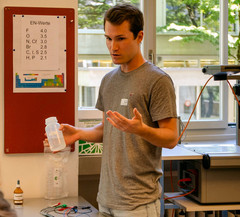
TFI goes TecDays
In July 2022, two PhDs of our Thin Films and Interfaces (TFI) Group offered a practical teaching module to pupils at the Kantonsschule Stadelhofen as part of the Swiss TecDays. These are one-day events at Swiss grammar schools, organized by the Schweizerische Akademie der Technischen Wissenschaften (SATW), to support and strengthen technology education at schools. By bringing together pupils and experts from industry, universities, or research institutions, TecDays aims to raise an early awareness for technology and science.

Woman in Science
Congratulations to our former postdoc, Alexandra Palla-Papavlu (4th from the left), for winning the L’Oreal Prize for Woman in Science(link is external) in the category Physics in Romania
Upcoming Seminars
TFI GUEST SEMINAR
Date: Monday 6 May, 2024, 16:00
Topic: TBA
Speaker: Prof. Marc Janoschek, Head of the Laboratory for Neutron and Muon Instrumentation (LIN) at PSI
Room: OFLG/402
TFI SEMINAR
Date: Monday 13 May, 2024, 16:00
Title: TBA
Speaker: Andrew Akbasheu
Room: OFLG/402
TFI Literature meeting
Date: Friday 24 May, 2024, 16:00
Speaker: Anna and Naga
Room: OFLA/002
TFI SEMINAR
Date: Monday 27 May, 2024, 16:00
Title: TBA
Speaker: Adil Baiju
Room: OFLG/402
TFI Literature meeting
Date: Monday 3 June, 2024, 16:00
Speaker: Timo and Xiaochun
Room: OFLG/401
Upcoming Conferences
April 2024
2024 MRS Spring Meeting & Exhibit
April 22-26, 2024 Seattle, Washington, USA
May 7-9, 2024 Virtual
More Information
June 2024
ECAPD 2024
European Conference on Applications of Polar Dielectrics
June 16-19, 2024 Trondheim, Norway
More Information
September 2024
iWOE-30 2024
International Workshop on Oxide Electronics
September 29.-2.October 2024 , Darmstadt, Germany
More Information
Scientific Highlights
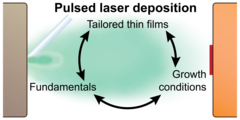
A practical guide to pulsed laser deposition
Nanoscale thin films are widely implemented across a plethora of technological and scientific areas, and form the basis for many advancements that have driven human progress, owing to the high degree of functional tunability based on the chemical composition. Pulsed laser deposition is one of the multiple physical vapour deposition routes to fabricate thin films, employing laser energy to eject material from a target in the form of a plasma ...
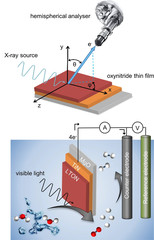
Momentum-resolved electronic structure of LaTiO2N photocatalysts by resonant Soft-X-ray ARPES
Oxynitrides are promising materials for visible light-driven water splitting. However, limited information regarding their electron-momentum resolved electronic structure exists. Here, with the advantage of the enhanced probing depth and chemical state specificity of soft-X-ray ARPES, we determine the electronic structure of the photocatalyst oxynitride LaTiO2N and monitor its evolution as a consequence of the oxygen evolution reaction. After the photoelectrochemical reactions, we observe a partial loss of Ti- and La-N 2p states, distortions surrounding the local environment of titanium atoms and, unexpectedly, an indication of an electron accumulation layer at or near the surface, which may be connected with either a large density of metallic surface states or downward band bending. The distortions and defects associated with the titanium 3d states lead to the trapping of electrons and charge recombination, which is a major limitation for the oxynitride LaTiO2N. The presence of an accumulation layer and its evolution suggests complex mechanisms of the photoelectrochemical reaction, especially in cases where co-catalysts or passivation layers are used.
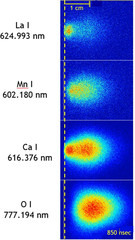
PLD plasma plume analysis, a summary of the PSI contribution
We report on the properties of laser-induced plasma plumes generated by ns pulsed excimer lasers as used for pulsed laser deposition to prepare thin oxide films. A focus is on the time and spatial evolution of chemical species in the plasma plume as well as the mechanisms related to the plume expansion. The overall dynamics of such a plume is governed by the species composition in particular if three or more elements are involved. We studied the temporal evolution of the plume, the composition of the chemical species in the plasma, as well as their electric charge. In particular, ionized species can have an important influence on film growth. Likewise, the different oxygen sources contributing to the overall oxygen content of an oxide film are presented and discussed. Important for the growth of oxide thin films is the compositional transfer of light element such as oxygen or Li. We will show and discuss how to monitor these light elements using plasma spectroscopy and plasma imaging and outline some consequences of our experimental results.
Student projects at the Thin Films and Interfaces Group
Most of the time we have student projects related to the work we do. Just talk to us if you are interested in something we are working on not advertised on our pages.
Currently, we are looking for a Semester or Master Student on the topic of ferroelectric field effect transistors (FeFETs).
If anyone is interested, please contact Prof. Dr. Thomas Lippert (thomas.lippert@psi.ch) or Dr Nikita Shepelin (nikita.shepelin@psi.ch).
PhD projects at the Thin Films and Interfaces Group
At present, we have no open PhD positions available. Other open positions are always published on the PSI Open Positions page.