Swiss Light Source - SLS
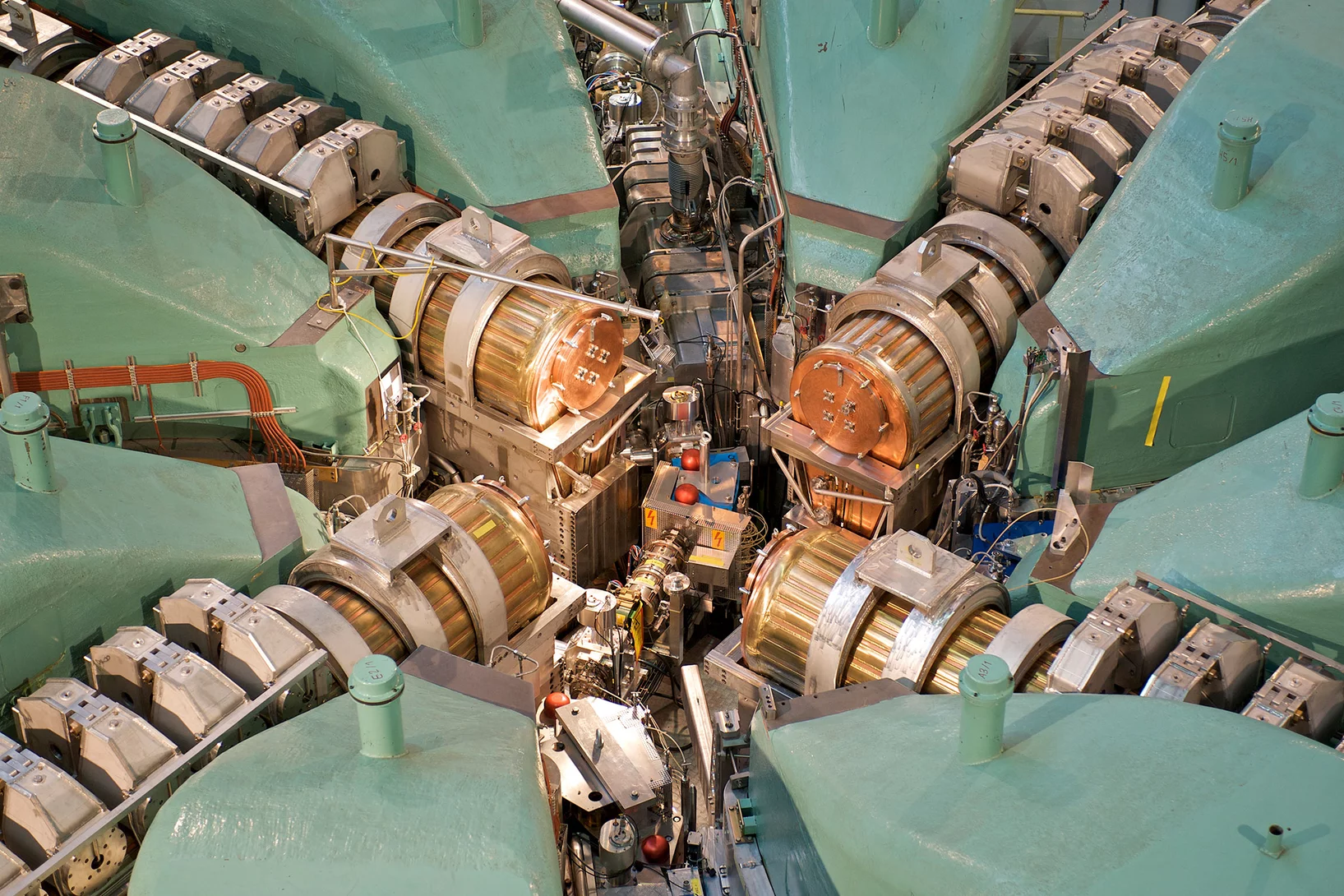
The Swiss Light Source (SLS) at the Paul Scherrer Institut is a third-generation synchrotron light source. With an energy of 2.4 GeV, it provides photon beams of high brightness for research in materials science, biology and chemistry.Upcoming Events
Space and Time-resolved in-situ XANES Studies of the Electrooxidation of Methanol and Ethanol on Platinum
D. Remaker, Chemistry Department, George Washington University, USAThursday, 24 May 2012; 11:00 am in WSLA/008
Mechanism of Aromatic Saturation Catalyzed by Pt
D.C. Koningsberger, Group of Inorganic Chemistry and Catalysis, Faculty of Science, Urecht University, The NetherlandsThursday, 24 May 2012; 11:30 am in WSLA/008
News
18. April 2012
Physicists observe the splitting of an electron inside a solid
An electron has been observed to decay into two separate parts, each carrying a particular property of the electron: a spinon carrying its spin – the property making the electron behave as a tiny compass needle – and an orbiton carrying its orbital moment – which arises from the electron’s motion around the nucleus. These newly created particles, however, cannot leave the material in which they have been produced.29. February 2012
Creating magnetism takes much longer than destroying it
Researchers at the Paul Scherrer Institute are finding out how long it takes to establish magnetism and how this happens. Establishing a magnetically ordered phase in the metallic alloy iron-rhodium takes much longer than the reverse process of demagnetization. The result comes from basic research, but has relevance for the computer industry, as it shows which processes limit the speed of magnetic data storage and where improvements might be made.This news release is only available in German.
7. February 2012
Using heat for storing data
An international research team has demonstrated a new way to record information on a magnetic medium without the use of a magnetic field. Instead, they found that they could record information using only a heat pulse. This method of recording might allow one to record Terabytes (1000s of Gigabytes) of information per second being 100s of times faster than present hard drive technology, and consumes much less energy by using heat without the need for a magnetic field. Using modern lithographic methods and x-ray microscopy, researchers from the Paul Scherrer Institute contributed considerably to this work.23. January 2012
It works: Ultrafast magnetic processes observed ‘live’ using an X-ray laser
In first-of-their-kind experiments performed at the American X-ray laser LCLS, a collaboration led by researchers from the Paul Scherrer Institute has been able to precisely follow how the magnetic structure of a material changes. The change of structure was initiated by a laser pulse, and investigated with the help of short X-ray pulses. It appears as if the structure begins to change 400 femtoseconds after the laser pulse strikes. Such investigations will be a major focus of research at the planned Swiss X-ray Laser, SwissFEL, at PSI.8. December 2011
New insights into the cell’s protein factory
Eukaryotic ribosomes are among the most complex cellular machineries of the cell. These large macromolecular assemblies are responsible for the production of all proteins and are thus of pivotal importance to all forms of life. Two independent research groups at the ETH Zürich and the Institute of Genetics and Molecular and Cellular Biology in Strasbourg have obtained new insights into the atomic structure of the eukaryotic ribosome. The results have been published in the journal Science. All diffraction data were measured with synchrotron light at the Swiss Light Source macromolecular crystallography beamline X06SA at the Paul Scherrer Institute.2. August 2011
Investigation of a new method for the diagnosis of cancer in breast tissue
The Paul Scherrer Institute PSI has developed a new breast cancer diagnostic method, and is now carrying out first tests on non-preserved human tissue in conjunction with Kantonsspital Baden AG. This new method should be able to reveal structures that cannot be seen using conventional mammography. Scientists from the research department at Philips are currently investigating the use of this process as the basis for application in medical practice.23. May 2011
X-ray methods help to understand brain disorders better
An international team of researchers has developed a new method for making detailed X-ray images of brain tissue, which has been used to make the myelin sheaths of nerve fibres visible. Damage to these protective sheaths can lead to various disorders, such as multiple sclerosis. The facility for creating these images of the protective sheaths of nerve cells is being operated at the Swiss Light Source (SLS), at the Paul Scherrer Institute.28. April 2011
Dectris AG gewinnt Aargauer Unternehmerpreis
Der Aargauer Unternehmerpreis geht in diesem Jahr an das Badener Hightech-Unternehmen Dectris. Verliehen wurde der von der Aargauer Kantonalbank gestiftete Unternehmerpreis anlässlich des Wirtschaftstages des Aargauer Gewerbeverbandes vor rund 450 Gästen. Dectris ist ein Spin-Off-Unternehmen der SLS und beschäftigt sich mit der Entwicklung und Produktion von Röntgenkameras mit weltweit führender Technologie.11. April 2011
The electron torus can help us to understand high-temperature superconductors
Paul Scherrer Institute researchers have, for the first time, observed a novel kind of object that can exist in materials with unusual electrical and magnetic properties. This object corresponds to a particular type of electron current, with the electron cloud having the form of a torus and the electrons flowing along the meridians of the torus. Now that the fundamental existence of such toroidal currents in solid materials has been proven, researchers expect that they will find them in other materials, too. Thus these currents may be able to explain the behaviour of high-temperature superconductors.26. November 2010
Röntgenpreis for X-Ray research goes to Christian David
On 26th November 2010, Christian David, scientist at the Laboratory for Micro and Nanotechnology, received the Röntgenpreis for research in radiation science. David pioneered a method to enhance the quality of X-ray images. He received the award jointly with Franz Pfeiffer from Technische Universität München who worked closely together with him.22. October 2010
First Experiments with Third LCLS Instrument Go to the Source / 'Source: SLAC Today'
The third round of experiments at the Linac Coherent Light Source began earlier this month at a whole new level of capability."This is the only place to get hard X-ray laser pulses," said Christian David, a researcher at the Paul Scherrer Institute in Switzerland and principal investigator on the first XPP user run, which wrapped up this week. "That's why we waited for XPP instead of submitting a proposal to any of the other instruments."
17. October 2010
Moving Monopoles Caught on Camera
For decades researchers have searched for magnetic monopoles – isolated magnetic charges that can move freely like electric charges. Now a team of researchers from the Paul Scherrer Institute and University College Dublin have been able to produce monopoles in the form of quasiparticles in an assembly of nanoscale magnets and have directly observed how they move.23. September 2010
Advanced imaging for bone research and materials science
High-resolution method for computed nano-tomography developedA novel nano-tomography method developed by a team of researchers from the Technische Universität München, the Paul Scherrer Institute and the ETH Zurich opens the door to computed tomography examinations of minute structures at nanometer resolutions. The new method makes possible, for example, three-dimensional internal imaging of fragile bone structures.
29. July 2010