High-quality electron beams pave the way for more compact and affordable X-ray free-electron lasers.

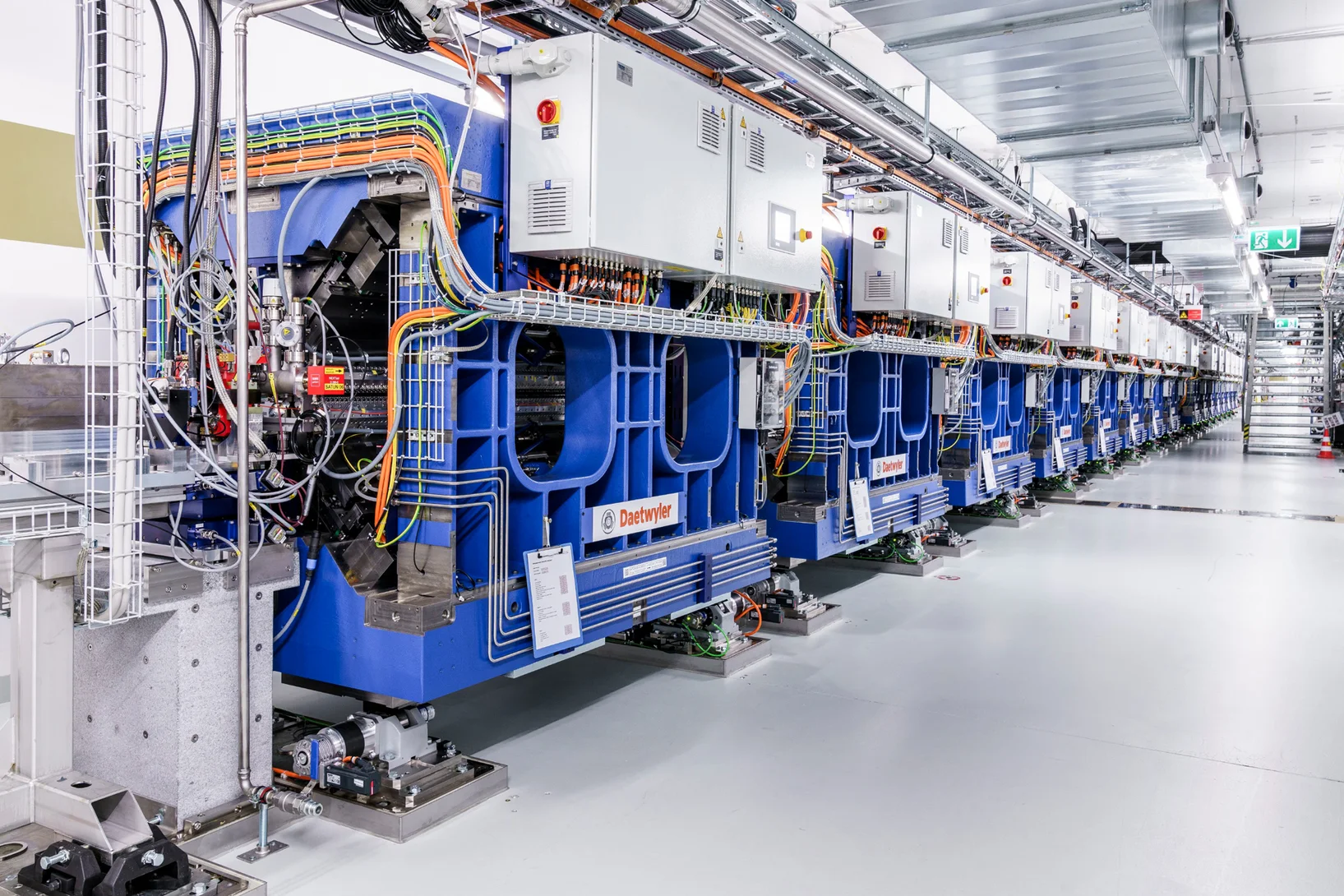
Scientists at the X-ray free electron laser SwissFEL have demonstrated that exceptional electron beam quality can offset the need for extreme accelerator energy at these advanced light sources. High-performance X-ray free-electron lasers act like ultra-fast cameras, capturing chemical reactions and mapping matter at the atomic scale. Traditionally, generating the shortest-wavelengths X-ray pulses required driving particle accelerators to massive energy levels. Instead of relying purely on brute force, researchers managed to achieve high-power, atomic-scale X-ray pulses by dramatically improving the brilliance of the electron beam, directly compensating for lower machine energy. This made it possible to operate the free-electron laser in a regime with very small electron oscillations in the undulator – a regime long thought to be impractical for high-power hard X-ray generation. The approach – already proven in user experiments – shows that optimizing beam quality can reduce energy demands, paving the way for smaller and more affordable X-ray free-electron laser facilities worldwide.

“This development has allowed us to push the SwissFEL minimum wavelength beyond the original design limit of 1 Å down to 0.75 Å, or increase the maximum photon energy from 12.4 keV to 16.5 keV. It should allow other facilities to do the same, provided they have a sufficient beam quality, and future machines could be more compact and cost-effective,” explains Eduard Prat, scientist in the beam dynamics group at SwissFEL who led the study.
By extending the wavelength range below one angstrom, SwissFEL can now provide enhanced spatial resolution, allowing scientists to observe matter with greater detail and access higher-energy processes that are inaccessible at longer wavelengths.
“The success was the result of many experts pushing the systems to the limits,” adds Prat.
Dr. Eduard Prat
PSI Center for Accelerator Science and Engineering
Paul Scherrer Institut PSI
+41 56 310 37 01
eduard.prat@psi.ch
Original Publication
-
Prat E, Arrell C, Calvi M, Hiller N, Juranić P, Kittel C, et al.
Subangstrom free-electron laser operation with undulator deflection parameter reaching the subunity regime
Physical Review Letters. 2026; 137(11): 115001 (6 pp.). https://doi.org/10.1103/dv32-v967
DORA PSI