
ADDAMS - X04SA: ADvanced DiffrAction for Materials Science
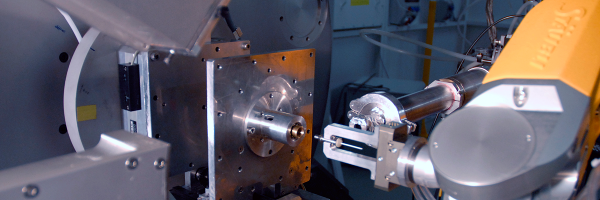
PLEASE NOTE THE SLS IS UNDERGOING A COMPREHENSIVE UPGRADE, NO APPLICATIONS ARE CURRENTLY POSSIBLE
2024
Energy range | 5 - 38 keV |
|---|---|
Flux (10 keV) | 2.5 x 10¹³ ph/s/0.4 A |
Focused spot size | 130 µm x 40 µm (1:1 focussing) |
General description and specifications
The ADDAMS beamline (formerly MS) is powered by a short-period (14 mm) in-vacuum, cryogenically cooled, permanent-magnet undulator, (CPMU, U14), while the front end and optics are designed to optimally exploit the characteristics of the U14 source.
We welcome applications for beamtime as for the normal non PX schedule.
A detailed description of the beamline from the undulator source to the endstations is available in this J. Synch. Rad. paper (open access). Please cite this paper in all publications that include in any part data recorded at the ADDAMS beamline.
The beamline sequentially serves two endstations, described briefly here:
Powder diffraction (PD)
Powder diffraction is performed in Experimental Hutch 1 (EH1). Responsible scientists are Nicola Casati and Antonio Cervellino. The Powder diffractometer works in Debye-Scherrer geometry and is equipped with a unique solid-state silicon microstrip detector, called MYTHEN (Microstrip sYstem for Time-rEsolved experimeNts), an outstanding in-house PSI detector group development (Bernd Schmitt, group leader and Anna Bergamaschi, MYTHEN III development).
The MYTHEN III detector is a general-purpose strip detector, with maximum resolution of 3.7 mdeg in 2θ, and very high efficiency and rapid acquisition times, with its simultaneous covering of 120 deg 2θ. This detector is particularly useful when either the scattering power is very low, or the acquisition times must be very short. It is therefore particularly suitable for time-resolved in-situ non-ambient XRPD and applications to the study of radiation sensitive materials, like organic compounds. MYTHEN III is also ideal for Industrial Applications of XRPD, particularly in the field of pharmaceuticals.
Several sample environments are available at the ADDAMS-1D station, controlling sample temperatures from 5 K to 1800 K, under gas and at high pressure, all interfaced with the MYTHEN II acquisition software. For a detailed list see here.
At the ADDAMS-PD station it is also possible to perform SR-XRPD experiments in combination with neutron PD experiments, the latter performed at the PSI Neutron facility SINQ facility. Once a year, users can submit joint XRPD and neutron-PD proposals via the so-called X-rays and neutrons (x+n) channel and if the proposal is accepted, the joint X+n beamtime allocation is coordinated by the SLS and SINQ beamline scientists (Nicola Casati and Antonio Cervellino at the SLS-2.0 ADDAMS and Denis Sheptyakov and Vladimir Pomjakushin at SINQ) so to sequentially perform the experiments. The joint X+n user operation is now a mature project with regular calls on Feb 15 each year, beamtime is allocated whenever possible and not necessarily at the same time in the two facilities. It is presently limited to crystallographic applications and only involves the SLS 2.0 - ADDAMS beamline Powder Station and the SINQ HRPT laboratory.
In-situ surface diffraction (SD)
In-situ surface diffraction is performed in Experimental Hutch 2 (EH2). The heart of the station is a large 2+3-circle surface diffractometer from Micro-Controle Newport, with two circles for the sample and three for the detector, plus a hexapod for precise alignment of the sample surface relative to the diffractometer axes. The diffractometer can be operated in two modes, either with a vertical, or a horizontal sample surface orientation.
The detector system is the PILATUS II novel photon-counting 2-D pixel detector, consisting of 486 x 195 pixels, each pixel subtending 0.0086o x 0.0086o. It also provides unsurpassed signal-to-noise ratios due to its zero electronic background noise, and has an excellent point spread function. The present maximum frame rate is 200 Hz. Typical surface diffraction experiments include recording crystal truncation rods, superstructure rods, reflectivity curves, in-plane diffraction, grazing-incidence small-angle scattering experiments, and time-resolved studies.
Current Highlights and News
Observing laser-induced recrystallization
Synchrotron X-ray diffraction sheds light on laser-induced local recrystallization .
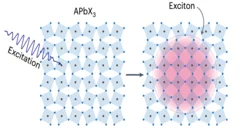
Excitons coupling to octahedral tilts in Pb nano-perovskites
Excitons coupling to octahedral tilts in Pb nano-perovskites
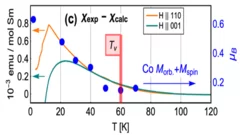
Crystal field rules heavy fermion delocalization in SmCoIn5
Crystal field rules heavy fermion delocalization