
Röntgenlicht liefert Einblicke in die Ursachen von Vulkanausbrüchen
Experimente am Paul Scherrer Institut bieten Einblicke in Vorgänge in vulkanischen Materialien, die darüber entscheiden wie heftig ein Vulkan ausbricht.
In dem Experiment hat ein internationales Forschungsteam mit einem Lasersystem ein kleines Stück vulkanisches Material so aufgeheizt, dass darin Bedingungen entstanden, wie sie am Beginn eines Vulkanausbruchs herrschen. Die Forschenden nutzten dann Röntgenlicht aus der Synchrotron Lichtquelle Schweiz SLS des Paul Scherrer Instituts PSI, um in Echtzeit zu verfolgen, was in dem Gestein passiert, während es schmilzt. Wesentlich für die Art einer Vulkaneruption ist die Geschwindigkeit, mit der sich Blasen im Vulkanmaterial bilden. Die Arbeit zeigt nun, dass die ersten Sekunden des Blasenwachstums über die Art der Eruption entscheiden. Die Ergebnisse erscheinen im Fachjournal Nature Communications.
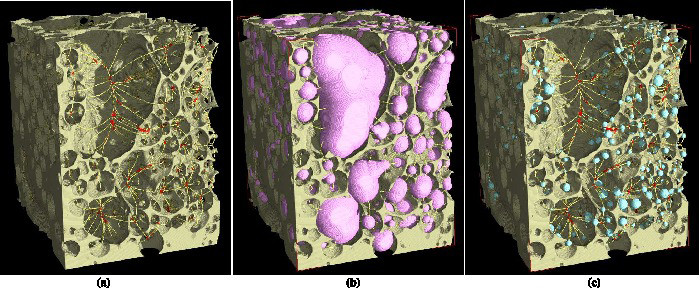
Skelett, das für die Bestimmung benötigt wird. Die beiden anderen Bilder zeigen die Sphären, die in die Struktur hineinkonstruiert werden und mit deren Hilfe man die interessanten Grössen bestimmen kann. (Graphik: F. Brun/Elletra; L. Mancini/Elletra)
Bitte beachten Sie: Alle Fotos und Grafiken dürfen ausschliesslich zur Illustration dieser Medienmitteilung benutzt werden. Ein Archivierung ist nicht gestattet. Bitte benennen Sie den Urheber.
Die Heftigkeit von Vulkanausbrüchen reicht von häufigen kleinen Eruptionen mit geringen Auswirkungen auf die Menschen und die Umwelt bis zu heftigen Eruptionen, die das Potenzial haben, ganze Zivilisationen zu zerstören. Auch wenn es verschiedene Faktoren gibt, die einen Vulkanausbruch auslösen, so spielt die Freisetzung von Wasser und Gasen aus dem geschmolzenen Gestein eine wichtige Rolle. Wenn das geschmolzene Gestein aus den Tiefen der Erde aufsteigt, erzeugt Wasser (und andere flüchtige Substanzen) Blasen im Gestein. Diese Blasen schwächen das Gestein und erzeugen gleichzeitig einen Pfad, auf dem die Gase entweichen können. Wenn sich die Blasen schneller ausdehnen als die Gase entweichen können, kommt es zu einem Vulkanausbruch. Dehnt sich das Gas langsamer aus, findet es einen günstigeren Pfad, über den es aus den Blasen entweichen kann, so dass sich die Gefahr eines Vulkanausbruchs verringert.
Blick ins Innere des flüssigen Vulkangesteins
Die Entstehung und Evolution von Blasen in geschmolzenem Basaltgestein (wie es um die Vulkane Stromboli und Ätna in Italien) standen im Mittelpunkt eines Projekts, das ein international zusammengesetztes Forschungsteam unter der Leitung von Don Baker von der McGill University (Kanada) durchgeführt hat. Die Experimente haben die Forschenden am Tomografie-Messplatz TOMCAT an der Synchrotron Lichtquelle Schweiz des Paul Scherrer Instituts durchgeführt. „Mit einem neuartigen lasergestützten Heizsystem und der Ausrüstung für die Darstellung schneller Prozesse am Messplatz TOMCAT haben wir die Veränderungen der Mikrostruktur des Materials in drei Dimensionen und in Echtzeit verfolgen können. Damit haben wir den Beginn der Blasenbildung im Innern eines kleinen Stücks Basaltschmelze Sekunde für Sekunde verfolgen können.“ erklärt Julie Fife, Wissenschaftlerin am TOMCAT-Messplatz. Die Forschenden konnten damit bestimmen, welchen Bedingungen für die Blasenbildung zu einem Ausbruch führen.
„Das komplexe Wechselspiel zwischen der Festigkeit des geschmolzenem Gesteins und seiner zunehmenden Gasdurchlässigkeit am Anfang der Blasenbildung deutet darauf hin, dass die Kombination dieser beiden Grössen darüber entscheidet, ob ein Vulkan heftig ausbricht oder ob die enthaltenen Gase still entweichen und höchstens kleinere Ausbrüche erzeugen“, erklärt Don Baker die Ergebnisse.
Die ersten Sekunden entscheiden über den Vulkanausbruch
Das wohl wichtigste Resultat dieser Untersuchungen deutet darauf hin, dass eine der heftigsten Eruptionsarten, die so genannte Plinianische Eruption, in den ersten zehn Sekunden der Blasenformung ausgelöst wird. Die rasche Zunahme der Zahl der Blasen führt dazu, dass das Gestein geschwächt wird und führt schliesslich zu einem Zusammenbruch der untersuchten Probe. Wenn das Magma nicht unmittelbar ausbricht, können ausreichende Pfade entstehen, über die das Gas entweichen kann, so dass sich das Risiko eines Ausbruchs reduziert. Diese Untersuchungen sind ein kleiner, aber wesentlicher Schritt zu dem Ziel, zukünftig weltweit die Typen von Vulkanausbrüchen voraussagen zu können.
Text: Julie L. Fife und Don Baker
Über das PSI
Das Paul Scherrer Institut entwickelt, baut und betreibt grosse und komplexe Forschungsanlagen und stellt sie der nationalen und internationalen Forschungsgemeinde zur Verfügung. Eigene Forschungsschwerpunkte sind Materie und Material, Mensch und Gesundheit, sowie Energie und Umwelt. Mit 1500 Mitarbeitenden und einem Jahresbudget von rund 300 Mio. CHF ist es das grösste Forschungsinstitut der Schweiz.
