Research with muons
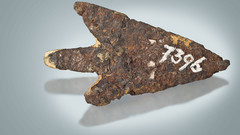
Bronze Age arrowhead is made of meteoritic iron
With the help of muons, PSI researchers were able to determine the origin of the material used for an arrowhead.

Hunting for the radius of a proton
0.000 000 000 000 840 87 (39) metres – scientists working at PSI have come up with this astonishing figure for the radius of a proton.
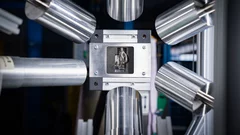
Hercules and batteries, X-rayed
With muons, PSI researchers can examine objects non-destructively. This helps in archaeology and battery development.
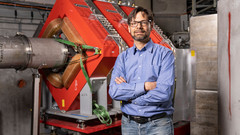
Two million Swiss francs granted to search for new physics
Philipp Schmidt-Wellenburg will set up a novel experiment at a muon beamline at PSI.
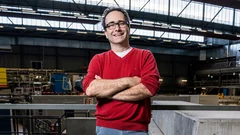
Size of helium nucleus measured more precisely than ever before
In experiments at the Paul Scherrer Institute PSI, an international research collaboration has measured the radius of the atomic nucleus of helium five times more precisely than ever before. The new value can be used to test fundamental physical theories.
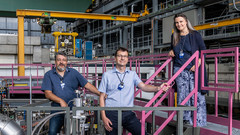
In search of new physics
With the high-intensity proton accelerator HIPA, the Paul Scherrer Institute generates elementary particles to clarify how the universe is structured. Using pions, muons, and neutrons, the researchers conduct experiments to test the standard model of particle physics.
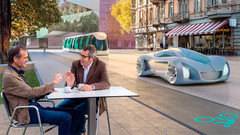
Now it's time for something new
If you make electronic components smaller, they unfortunately get hotter. Also, we will soon reach the limit of technically feasible miniaturisation. At PSI, Gabriel Aeppli and Christian Rüegg are working on fundamentally new, physical solutions for better computers and data storage devices.
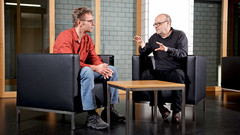
We start with 500 million muons
Materials for future electronics can be studied with muons. In this interview, PSI researchers Alex Amato and Thomas Prokscha explain the special characteristics of these elementary particles.
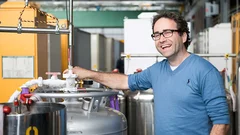
The hard worker from Val Mesolcina
For Aldo Antognini, physics and conviviality are in the bloodPSI researcher Aldo Antognini has received more than 2.2 million Swiss francs from the EU for his latest experiment. He wants to find out how magnetism is distributed in the proton. The particle physicist will be able to apply not only his scientific and technical talents, but his social flair as well.
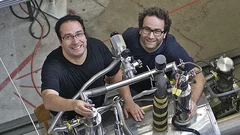
The deuteron too poses a mystery
The deuteron — just like the proton — is smaller than previously thoughtThe deuteron — one of the simplest atomic nuclei, consisting of just one proton and one neutron — is considerably smaller than previously thought. This new research finding fits with a 2010 study in which, similarly, the proton was measured at the Paul Scherrer Institute and, likewise, a smaller value than expected was found. The result from 2010 formed the basis for what has been known since then as the proton radius puzzle.
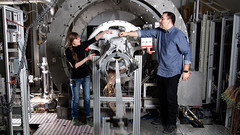
Five hundred thousand times less likely than winning the lottery
Measuring the rarity of a particle decayIn the so-called MEG experiment at the PSI, researchers are searching for an extremely rare decay signature from a certain kind of elementary particles known as muons. More precisely, they are quantifying its improbability. According to their latest number, this decay occurs less than once in 2.4 trillion events. By means of this result, theoretical physicists can sort out which of their approaches to describing the universe will hold up against reality.
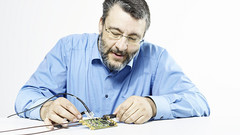
Measuring the simultaneity
What does a physicist do when his experiment needs an extremely precise time measurement? So precise that existing electronics cannot help him? A scientist from the Paul Scherrer Institute PSI simply decided to develop his own solution. The result is called DRS4, a high-precision electronic chip that could unlock the physics of our entire universe. As an additional benefit, the chip is already helping doctors to localise brain tumours with great accuracy.
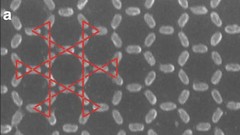
Tiny magnets mimic steam, water and ice
Researchers at the Paul Scherrer Institute (PSI) created a synthetic material out of 1 billion tiny magnets. Astonishingly, it now appears that the magnetic properties of this so-called metamaterial change with the temperature, so that it can take on different states; just like water has a gaseous, liquid and a solid state.
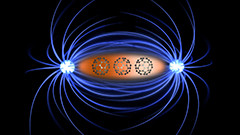
Magnets made of non-magnetic metals
For the first time, an international research team has demonstrated how to generate magnetism in metals that aren’t naturally magnetic, such as copper. The discovery could help develop novel magnets for a wide range of technical applications. Crucial measurements to understand this phenomenon were carried out at PSI à the only place where magnetic processes inside materials can be studied in sufficient detail.
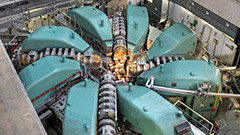
The proton accelerator at the Paul Scherrer Institute: forty years of top-flight research
Materials research, particle physics, molecular biology, archaeology à for the last forty years, the Paul Scherrer Institute’s large-scale proton accelerator has made top-flight research possible in a number of different fields.
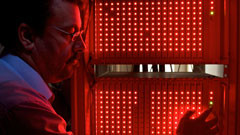
The quest for an elusive white crow of particle physics
A very rare process in nature should best decide on how we should describe our universe in the future. It is the particular decay of a particular type of elementary particle: the muon. These particles are short-lived and decay into a variety of other particles. According to one theoretical model, a very particular decay process is practically forbidden, whereas according to another it should be allowed. Which theory is correct? By observing many hundreds of trillions of muon decays very precisely, physicists at the Paul Scherrer Institut have come a step closer to solving this puzzle. They have now published their results in the journal Physical Review Letters.
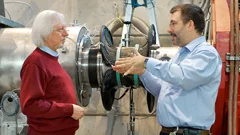
Experiments in millionths of a second
Muons à unstable elementary particles à provide scientists with important insights into the structure of matter. They provide information about processes in modern materials, about the properties of elementary particles and the nature of our physical world. Many muon experiments are only possible at the Paul Scherrer Institute because of the unique intense muon beams available here.
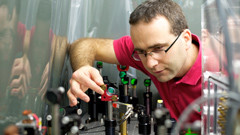
Proton size puzzle reinforced!
An international team of scientists confirmed the surprisingly small value of the proton radius with laser spectroscopy of exotic hydrogen. The experiments were carried out at PSI which is the only research institute in the world providing the necessary amount of muons for the production of the exotic hydrogen atoms made up of a muon and a proton.
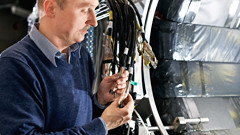
The weak side of the proton
An international research team has determined with a high level of accuracy, how the proton participates in the weak interaction à one of the fundamental forces of nature. Their results confirm the predictions of the Standard Model of particle physics. The experiment observed the probability of muon capture by protons à a process governed by the weak interaction. The experiment was conducted at the Paul Scherrer Institute, the only institute in the world with an accelerator capable of generating enough muons for carrying out this project in a realistic timeframe.
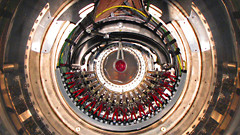
Erkenntnis aus dem Nichts
Zwei Experimente mit massgeblicher Beteiligung von Forschern des Paul Scherrer Instituts PSI liefern wichtige Ergebnisse bei der Suche nach der richtigen Beschreibung der Welt der kleinsten Teilchen. In den Experimenten haben die Physiker nach sehr seltenen Teilchenzerfällen gesucht. In beiden Fällen konnte der gesuchte Zerfall nicht beobachtet werden wodurch bestimmte Modelle der Teilchenphysik ausgeschlossen werden konnten.This news release is only available in German.
