
Particle physics
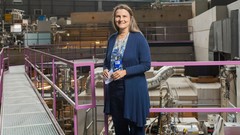
„IMPACT is very important in terms of international competition“
Daniela Kiselev talks about the upgrade planned at PSI's proton accelerator facility.

Hunting for the radius of a proton
0.000 000 000 000 840 87 (39) metres – scientists working at PSI have come up with this astonishing figure for the radius of a proton.
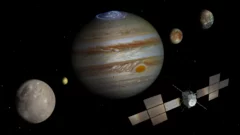
Jupiter mission to explore conditions conducive to life
Ganymede, Callisto and Europa: Jupiter’s icy moons are the destination of the upcoming ESA mission. On board: a high-tech detector developed by PSI.
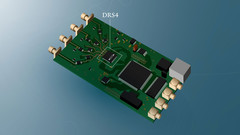
What can’t be bought, we develop ourselves
Many components for the experiments the researchers at PSI just develop themselves.
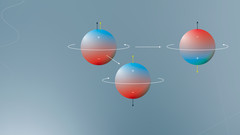
More light in the darkness
At PSI, researchers want to fill the missing gaps in the Standard Model of particle physics with the help of the large research facilities.
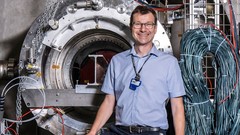
“A jewel we must treasure”
HIMB is one of the two parts of the upgrade project IMPACT. Klaus Kirch speaks about the plans.
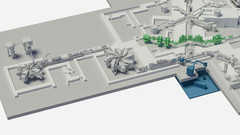
A two-part upgrade for the proton accelerator
A two-part upgrade is planned for HIPA starting in 2025. Preparations are already under way.
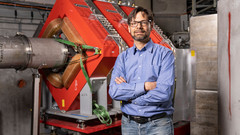
Two million Swiss francs granted to search for new physics
Philipp Schmidt-Wellenburg will set up a novel experiment at a muon beamline at PSI.
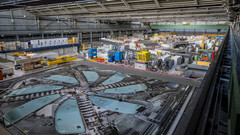
The Swiss research infrastructure for particle physics CHRISP
Researchers are looking for deviations in the current standard model of physics and want to find out how our universe is constructed.
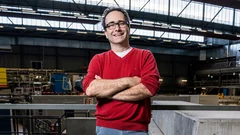
Size of helium nucleus measured more precisely than ever before
In experiments at the Paul Scherrer Institute PSI, an international research collaboration has measured the radius of the atomic nucleus of helium five times more precisely than ever before. The new value can be used to test fundamental physical theories.
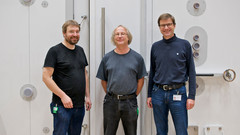
Magnetically shielded from the rest of the world
At the Paul Scherrer Institute PSI, researchers together with a company have constructed a room that is one of the best magnetically shielded places on the earth. With its help, they want to solve the last mysteries of matter and answer a fundamental question: Why does matter - and thus why do we - exist at all?
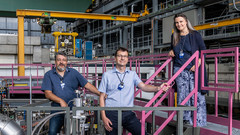
In search of new physics
With the high-intensity proton accelerator HIPA, the Paul Scherrer Institute generates elementary particles to clarify how the universe is structured. Using pions, muons, and neutrons, the researchers conduct experiments to test the standard model of particle physics.
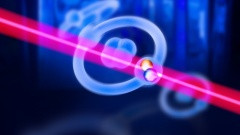
Long-lived pionic helium: Exotic matter experimentally verified for the first time
Exotic atoms, in which electrons are replaced by other particles, allow deep insights into the quantum world. After eight years, an international group of scientists have succeeded in a challenging experiment conducted at PSI’s pion source: they created an artificial atom called “pionic helium”.
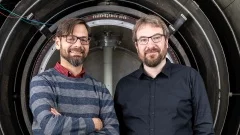
Tracking down the mystery of matter
At the ultracold neutron source at PSI, researchers have measured a property of the neutron more precisely than ever before: its electric dipole moment. That's because the search is still on for an explanation of why, after the Big Bang, there was more matter than antimatter.
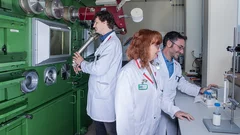
Material from PSI helps to check inconsistencies in the Big Bang theory
Shortly after the Big Bang, radioactive Beryllium-7 atoms were formed, which today, throughout the universe, they have long since decayed. A sample of beryllium-7 artificially produced at PSI has now helped researchers to better understand the first minutes of the universe.
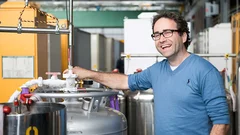
The hard worker from Val Mesolcina
For Aldo Antognini, physics and conviviality are in the bloodPSI researcher Aldo Antognini has received more than 2.2 million Swiss francs from the EU for his latest experiment. He wants to find out how magnetism is distributed in the proton. The particle physicist will be able to apply not only his scientific and technical talents, but his social flair as well.
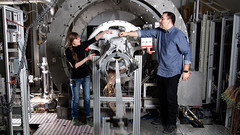
Five hundred thousand times less likely than winning the lottery
Measuring the rarity of a particle decayIn the so-called MEG experiment at the PSI, researchers are searching for an extremely rare decay signature from a certain kind of elementary particles known as muons. More precisely, they are quantifying its improbability. According to their latest number, this decay occurs less than once in 2.4 trillion events. By means of this result, theoretical physicists can sort out which of their approaches to describing the universe will hold up against reality.
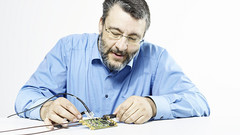
Measuring the simultaneity
What does a physicist do when his experiment needs an extremely precise time measurement? So precise that existing electronics cannot help him? A scientist from the Paul Scherrer Institute PSI simply decided to develop his own solution. The result is called DRS4, a high-precision electronic chip that could unlock the physics of our entire universe. As an additional benefit, the chip is already helping doctors to localise brain tumours with great accuracy.
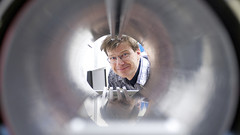
New method will enable most accurate neutron measurement yet
Our universe consists of significantly more matter than existing theories are able to explain. This is one of the great puzzles of modern science. One way to clarify this discrepancy is via the neutron’s so-called electric dipole moment. In an international collaboration, researchers at PSI have now devised a new method which will help determine this dipole moment more accurately than ever before.
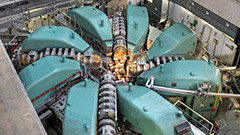
The proton accelerator at the Paul Scherrer Institute: forty years of top-flight research
Materials research, particle physics, molecular biology, archaeology à for the last forty years, the Paul Scherrer Institute’s large-scale proton accelerator has made top-flight research possible in a number of different fields.
