
Die jüngste Grossforschungsanlage des PSI erzeugt sehr kurze Pulse von Röntgenlicht mit Lasereigenschaften. Damit können Forschende extrem schnelle Vorgänge wie die Entstehung neuer Moleküle bei chemischen Reaktionen verfolgen, die detaillierte Struktur lebenswichtiger Proteine bestimmen oder den genauen Aufbau von Materialien klären. Die Erkenntnisse erweitern unser Verständnis der Natur und führen zu praktischen Anwendungen wie etwa neuen Medikamenten, effizienteren Prozessen in der chemischen Industrie oder neuen Materialien in der Elektronik.

Wie der SwissFEL funktioniert

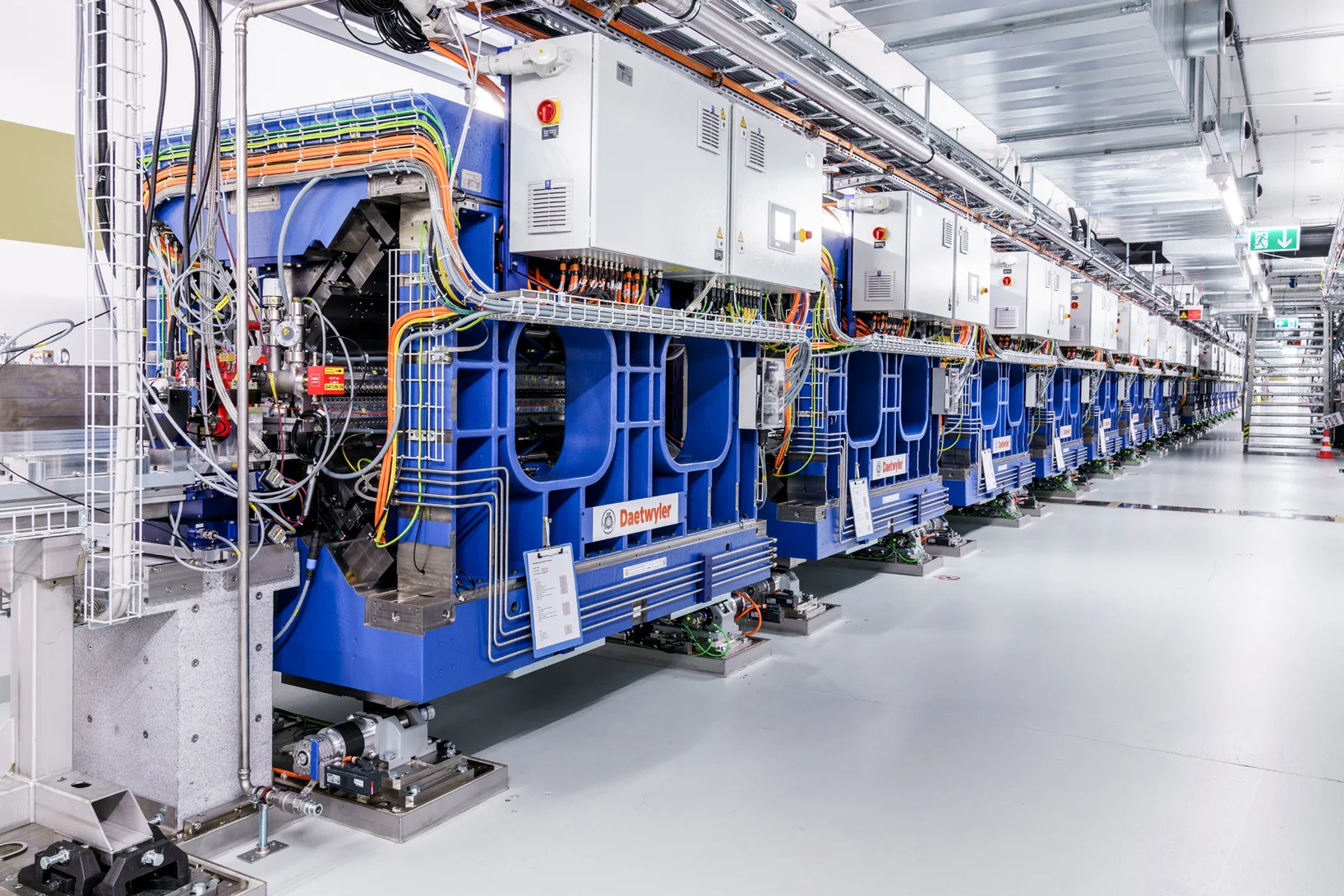
Die Anlage erstreckt sich über eine Länge von 740 Metern und besteht aus vier Teilen: Injektor mit Elektronenquelle, Linearbeschleuniger, einer Anordnung von Undulatoren und Experimentiereinrichtungen.
Der SwissFEL ist ein Freie-Elektronen-Röntgenlaser (das FEL im Namen steht für Free Electron Laser). Er erzeugt extrem kurze und intensive Blitze aus Röntgenlicht in Laserqualität– die Blitze sind 1 bis 60 Femtosekunden (1 Femtosekunde = 0,000 000 000 000 001 Sekunden) lang. Diese Eigenschaften erlauben neuartige Einblicke in das Innere von Materialien, die mit den Röntgenblitzen durchleuchtet werden.
Die Erzeugung des Röntgenlichts beginnt im Inneren der Elektronenquelle: Mit einem Lichtblitz werden Elektronen aus einer Metallplatte freigesetzt und dann durch ein elektrisches Feld im Linearbeschleuniger auf die nötige hohe Geschwindigkeit gebracht. Dabei werden die Elektronen so schnell, als hätten sie eine Spannung von 6 Milliarden Volt durchlaufen. Damit sind sie schnell genug, um in Undulatoren – so nennen die Fachleute die verwendete Magnetanordnung – auf eine schlangenförmige Bahn geschickt zu werden. Dabei erzeugen die Elektronen die Röntgenlichtstrahlung, die sich gleichsam mit der Gewalt einer Lawine zu dem einzigartig intensiven Röntgenlicht des SwissFEL verstärkt. Dazu sind am SwissFEL auf 60 Metern 12 Undulatoren mit je 1060 Magneten hintereinander angeordnet. Der Röntgenlichtstrahl wird nun zum Experimentierplatz weitergeleitet und steht dort Forschenden für ihre Experimente zur Verfügung.
Neue Erkenntnisse für Wissenschaft, Technik und Medizin
Die Röntgenlichtpulse sind so lichtstark, dass sich mit ihnen Filme der Bewegung von Atomen und Molekülen erstellen lassen. Am SwissFEL kann man beispielsweise Schritt für Schritt verfolgen, wie sich in einer chemischen Reaktion die kleinsten Bausteine einer Substanz voneinander trennen und zu einer neuen Substanz zusammenfinden. Diese Vorgänge sind so schnell, dass sie nur schwer beobachtet werden konnten. Die extrem kurzen Blitze des SwissFEL machen es jedoch möglich, die einzelnen Zwischenschritte mit kurzer Belichtungszeit abzulichten. Ein genaues Verständnis dieser Abläufe kann helfen, Verfahren in der chemischen Industrie effizienter und damit kostengünstiger oder ressourcenschonender ablaufen zu lassen.

Auch kann man am SwissFEL bestimmen wie lebenswichtige biologische Moleküle im Detail aufgebaut sind. Solche Moleküle bestehen meist aus zehntausenden von Atomen und es ist entscheidend für ihre Funktion, dass die Atome richtig angeordnet sind. Diese Erkenntnisse könnten die Grundlage neuer Medikamente werden, indem sie beispielsweise aufzeigen, wie man wichtige Lebensprozesse in krankheitserregenden Bakterien unterbindet.
Standort und Umgebung

Der SwissFEL befindet sich im Würenlinger Wald in der Nähe des PSI-Geländes im Kanton Aargau. Dieser Standort hat sich nach umfangreichen Abwägungen als der einzig geeignete erwiesen. Hier sind Temperaturschwankungen und Erschütterungen besonders gering, was für einen erfolgreichen Betrieb der hochpräzisen Anlagen entscheidend ist. Die Nähe zum PSI-Gelände ermöglicht es, dank der kurzen Wege die vorhandene Infrastruktur des Instituts zu nutzen. Grosse Teile des Gebäudes wurden mit Erde und Kies abgedeckt, so dass ein natürlicher Lebensraum für bedrohte Pflanzen- und Tierarten entstanden ist.
Weiterführende Informationen
- Internetseite des SwissFEL-Projekts (in Englisch)
- Film zur neuen Grossanlage SwissFEL
- Kamerafahrt durch den SwissFEL
News

Schweizer Röntgenlaser enthüllt, wie Elektronen zusammenspielen
Ein neues Röntgenverfahren am SwissFEL macht den «Tanz» der Elektronen sichtbar – und könnte erklären, warum Quanteninformationen so leicht verloren gehen.
Synchronising ultrashort X-ray pulses
Attosecond coherent pulses at SwissFEL will open new experimental possibilities

Disorder begins at the surface of quantum materials
Ultrafast X-rays from SwissFEL reveal unexpected light responses in quantum materials.