Enviroment
23. May 2013
Waste incineration: the last word in cleanliness?
Energy and Environment EnvironmentHousehold waste always used to end up left untreated in landfills, and the effects of this practice are well-known: these waste disposal sites were quite often ecological "death zones". With the incineration of municipal waste, there was some mitigation of this problem: despite the overall increase in quantities of waste, the areas claimed by landfill have been limited in recent decades thanks to waste recycling and incineration. However, waste incineration remains far from a panacea. Some combustion products that are already present in the burnt materials or that arise just during the combustion process itself are harmful to human health and the environment and some of them still find their way out of waste incineration plants and into landfill sites as their final destination.
10. May 2013
Air quality in the megacity Paris better than expected
Energy and Environment EnvironmentMegacities are often perceived by the public to be major sources of air pollution, which affect their surroundings as well. However, recent studies show that the environmental credentials of cities with over one million inhabitants are not so bad after all. An international team of researchers, including scientists from the Paul Scherrer Institute (PSI), has now confirmed, on the basis of aerosol measurements carried out in Paris, that so-called post-industrial cities affect the air quality of their immediate surroundings far less than might be thought.
27. February 2013
Ice and snow – the great unknowns of science
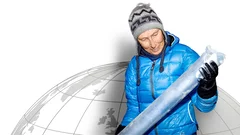
Energy and Environment EnvironmentIce and snow have fundamental significance for our climate. Generally speaking, one assumes that science knows everything that is important about such everyday phenomena. Yet, as soon as one looks at the whole at the molecular level, many questions remain unanswered. This knowledge is essential for predicting the future of our planet. Thorsten Bartels-Rausch in an interview about the great unknowns.
16. October 2012
X-rays provide insights into volcanic processes
Media Releases Research Using Synchrotron Light Environment User ExperimentsExperiments performed at the Paul Scherrer Institute (PSI) investigate processes inside volcanic materials that determine whether a volcano will erupt violently or mildly. In the experiments, scientists heated small pieces of volcanic material similarly to conditions present at the beginning of a volcanic eruption. They used X-rays from the SLS to observe, in real time, what happens to the rock as it goes from the solid to the molten state.
13. June 2012
Top Science at the Top of Europe
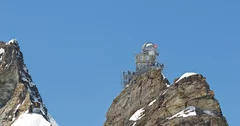
Energy and Environment EnvironmentDas PSI ist in der Jubiläumsausstellung auf dem Jungfraujoch prominent vertreten
75 Jahre Sphinx-Observatoirum und 100 Jahre Jungfraubahnen: Dies ist der Anlass für eine Ausstellung der internationalen Stiftung Hochalpine Forschungsstationen Jungfraujoch und Gornergrat, die im Frühjahr eröffnet wurde.
This news release is only available in German.
22. May 2012
Reconstruction of atmospheric lead concentrations in Russia since 1680
Media Releases Energy and Environment EnvironmentA research team from the Paul Scherrer Institute has reconstructed the concentration record of lead in the atmosphere in Russia since 1680. The results demonstrate a significant increase in the atmospheric lead concentrations since the 1930s and a significant reduction since the 1970s.
25. August 2011
Klimaforschung am Teilchenbeschleuniger: Beschreibung der Aerosolneubildung muss revidiert werden
Media Releases Energy and Environment EnvironmentVom Menschen verursachte Aerosole wirken in der Atmosphäre kühlend: Klimaforscher nehmen an, dass sie einen Grossteil des anthropogenen Treibhauseffekts kompensieren. Allerdings müssen sich die Partikel zum Teil in der Atmosphäre erst neu bilden. Diesen bisher kaum untersuchten Prozess nimmt das CLOUD-Experiment am CERN, an dem auch Forscher des Paul Scherrer Instituts beteiligt sind, unter die Lupe. Dabei wurde erstmals ein Teilchenbeschleuniger für die Untersuchung von Vorgängen in der Atmosphäre eingesetzt. Die Ergebnisse zeigen: die Beschreibungen der Aerosolbildung in Klimamodellen muss revidiert werden.
This news release is only available in German.
21. February 2011
Russ lässt Himalaya-Gletscher schneller schmelzen
Media Releases Energy and Environment EnvironmentForschende des Paul Scherrer Instituts haben zusammen mit Kollegen aus China und den USA gezeigt, dass die Klimaerwärmung nicht alleine für die Gletscherschmelze im Himalaya verantwortlich ist. Auch Russ, der auf dem Gletscher abgelagert wird, trägt dazu bei. Der Russ entsteht, wenn Öl oder Holz verbrannt werden; Wind transportiert ihn dann in den Himalaya.
This news release is only available in German.
19. April 2010
The mass concentration of volcanic ash from Iceland in European airspace
Media Releases Energy and Environment EnvironmentData of the Paul Scherrer Institute from the High-Alpine Research Station Jungfraujoch yield important information.
The eruption of the volcano Eyjafjallajokull in Iceland has stalled flight traffic in large parts of Europe. Decision makers had to base their decisions mainly on model calculations for the volcanic plume dispersion. How dangerous is this volcanic ash layer for planes?
18. January 2010
News from the smog chamber: mechanisms of particle formation in the atmosphere unveiledt
Media Releases Environment Energy and EnvironmentUp to the present time, the nucleation or new formation of particles in the atmosphere has been a great enigma. Until recently, research was based on the assumption that sulphuric acid played the central role in particle formation. However, laboratory experiments and field tests have consistently provided conflicting results. In the lab, considerably higher concentrations of sulphuric acid are required for nucleation to take place than in the atmosphere itself. Now scientists from the Paul Scherrer Institute (PSI) have found out the cause for these conflicting results from their smog chamber. These findings will advance climate research to a significant degree.
10. December 2009
Mystery solved: how fine particulates are formed in the air
Media Releases Environment Energy and EnvironmentResearchers from the Paul Scherrer Institute, the University of Colorado and 29 other research institutions in various countries have investigated the composition of the organic constituents of the fine particulates found in various regions of the world, and have identified the original substances from which they are formed in each case. For the first time ever, this has enabled them to explain the role played by the individual components of emissions in the development of fine particulates.
19. December 2008
Temperature response in the Altai lags solar forcing
Media Releases Energy and Environment EnvironmentPublication in Geophysical Research Letters. New results from climate research using ice cores from the Siberian Altai. The observation that the reconstructed temperatures followed the solar forcing with a delay of 10 to 30 years is particularly interesting.