lns header.png

LNS: Laboratory for Neutron Scattering

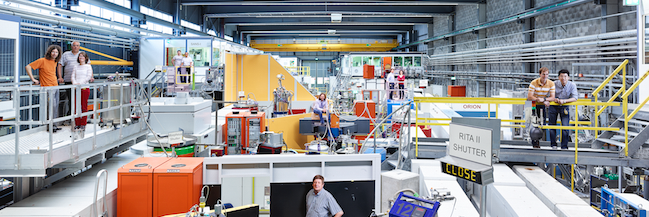
The Laboratory for Neutron Scattering (LNS) at the Paul Scherrer Institute is responsible for the scientific exploitation, operation and development of neutron scattering instruments at the Swiss Spallation Neutron Source (SINQ). The team of 35 senior scientists, postdoctoral researchers and PhD students further collaborates on diverse research projects ranging from modern topics in condensed matter physics and materials science to pressing questions in energy research and health care. read more


Master and Bachelor work at the LNS

We offer students the possibility to do their educational research at our facilities. See Teaching and Education for detailed information on Master/Diploma thesis, Bachelor/Semester work and practical courses at the LNS. Currently we have two open positions for Master thesis projects: Spin and orbital liquids in frustrated spinels AB2X4 and Monopole hopping mechanism in spin ice.


News


2. May 2012

phasediagram1.jpg

Direct observation of the quantum critical point in heavy fermion CeRhSi3

N. Egetenmeyer et al., Physical Review Letters 108, 177204 (2012). In many heavy fermion materials the quantum critical point is masked by superconductivity and it can only be detected by use of a local probe. In the noncentrosymmetric heavy fermion CeRhSi3 the ground state at ambient pressure is antiferromagnetically ordered and superconductivity sets in above 12 kbar coexisting with antiferromagnetism. We have unraveled a magnetic quantum critical point hidden deep inside the superconducting state of CeRhSi3. Using the muon spin rotation technique we observed the suppression of the internal fields at the lowest measured temperature, upon increase of external pressure. Our data suggest that the ordered moments are gradually quenched with increasing pressure. At 23.6 kbar, the ordered magnetic moments are fully suppressed via a second-order phase transition, and TN is zero.


2. April 2012

staedele1.jpg

Ellipsoidal hybrid magnetic microgel particles with thermally tunable aspect ratios

V. Städele et al., Soft Matter 8, 4427-4431 (2012). We report on the synthesis and characterization of multiresponsive hybrid microgel particles. The particles consist of ellipsoidal silica-coated maghemite cores subsequently coated with thermoresponsive poly (N-isopropylacrylamide) (PNIPAM) shells. The PNIPAM shell enables the hybrid particle to alter its size and ratio of long to small axis with increasing temperature while the core morphology remains unchanged. The maghemite core can be magnetically oriented along the long axis as evidenced by small-angle X-ray scattering (SAXS) and confocal microscopy. Dynamic light scattering techniques and confocal microscopy have been applied to study the particles' morphological evolution with increasing temperature in terms of their aspect ratio. The aspect ratio of the particles was found to vary from 1.25 to 1.45 within a temperature range from 20 °C to 44 °C.


20. February 2012

white.jpg

Directly coupled Ferromagnetism and Ferroelectricity in the Olivine Mn2GeO4

J.S. White et al., Physical Review Letters 108, 077204 (2012). The olivine compound Mn2GeO4 is shown to feature both a ferroelectric polarization and a ferromagnetic magnetization that are directly coupled and point along the same direction. We show that a spin spiral generates ferroelectricity, and a canted commensurate order leads to weak ferromagnetism. Symmetry suggests that the direct coupling between the ferromagnetism and ferroelectricity is mediated by Dzyaloshinskii-Moriya interactions that exist only in the ferroelectric phase, controlling both the sense of the spiral rotation and the canting of the commensurate structure. Our study demonstrates how multicomponent magnetic structures found in magnetically frustrated materials like Mn2GeO4 provide a new route towards functional materials that exhibit coupled ferromagnetism and ferroelectricity.


Contact

Laboratory Head
Dr. Christian Rüegg
Phone: +41 56 310 4778

Secretary
Pamela Knupp
Phone: +41 56 310 2087
Fax: +41 56 310 2939

Address
Laboratory for Neutron Scattering
Paul Scherrer Institut
CH-5232 Villigen PSI
Switzerland

Call for Proposals

Next submission deadline:
May 15, 2012, midnight

More Information